I will be the first to admit that there are plenty of westerns I have never seen (good, bad, or indifferent). I’m sure there are several reasons why, but I’m only going to share the most obvious one. I’ve grown extremely accustomed to the “action western.” If there wasn’t some sort of white hat-wearing gunslinger there to exact justice, I felt it really wasn’t worth my attention.
Between the ages of twelve and sixteen, my father introduced me to two movies that helped shape what I felt were then—and still are today—the quintessential films of the western genre. Both occupy the number one and number two slots and have become the standard by which I measure everything else I’ve seen since then.
As my palate matured, so did my understanding of westerns. I started to appreciate not only the “action western,” but also stories set in the American West that featured multi-layered characters or narratives not driven solely by action. I also began to recognize and admire works that were entirely different—or at least deviated from the mainstream of the stereotypical Hollywood western.
Here are my Top Ten Favorite Westerns:
10. THE OUTLAW JOSEY WALES
Year Released: 1976
Director: Clint Eastwood
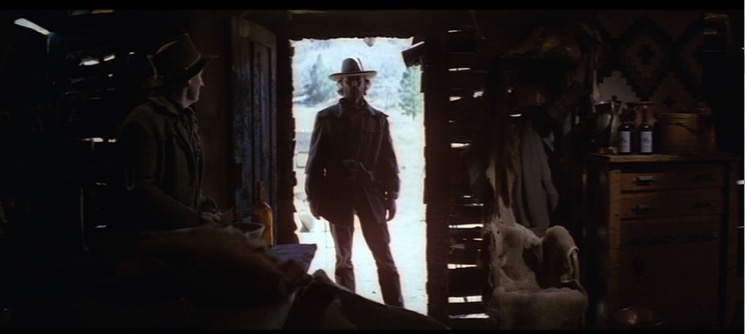
By the time I first saw The Outlaw Josey Wales, I had already begun my fascination with Clint Eastwood. But once I grabbed his biography off a bookstore bargain rack, I was hooked.
In The Outlaw Josey Wales, Clint Eastwood portrays the title character, Josey Wales, a farmer in Missouri who joins a Confederate guerrilla unit after his family is slaughtered by the Union Army. Josey’s main objective is vengeance: to hunt down those who destroyed his life. Along the way, he encounters quite an assortment of characters who end up joining him on his journey, with or without his consent. By the end, the tables turn, and he finds himself pursued by the very men who killed his family, leading to a rather satisfying climax.
My View: The Outlaw Josey Wales is one of Clint Eastwood’s best directorial efforts. Unlike the “Man with No Name,” he gives the audience a great deal of sympathy for Josey, making the character much easier to identify with. The film is beautifully woven with witty and humorous dialogue—something not always common in his westerns—and Chief Dan George, as Lone Watie, steals nearly every scene opposite him.
Best Line:
Josey Wales: “When I get to likin’ someone, they ain’t around long.”
Lone Watie: “I notice when you get to dislikin’ someone they ain’t around for long neither.”
9. OPEN RANGE
Year Released: 2003
Director: Kevin Costner
At one point in time, Kevin Costner could do no wrong. Then, in 1995, Waterworld was released, and American moviegoers weren’t sure if what they had been investing in for the past ten years was still paying off. Suddenly, Costner was no longer a guaranteed blockbuster star—at least in the eyes of the studios. Since then, his films have been hit or miss. Then along came Open Range.
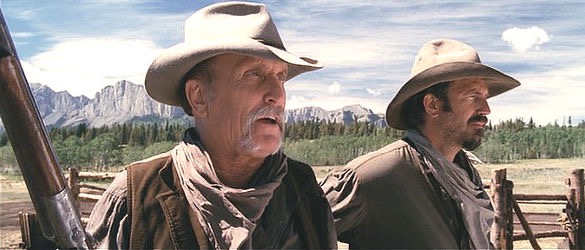
While battling pneumonia and later a burst appendix throughout production, Kevin Costner still managed to bring to the screen what many audiences believed was dead: another great American western. The film takes place in post-Civil War America, where the frontier is quickly losing its majesty as ranchers and entrepreneurs buy up as much land as they can get their hands on. Boss Spearman (Robert Duvall) and Charley Waite (Costner) are two cattlemen who run into more trouble than either wants when they are bullied by a rancher and his “hired guns,” who despise their free-grazing philosophy.
My View: Costner successfully brings to life an American West that most viewers have never seen before: the potential evils of entrepreneurship and the lingering scars of a violent and bloody Civil War. The pacing is a bit slow, but it never detracts from the simple yet complex story of redemption. Costner should also be credited for portraying one of the most realistic gunfights ever filmed.
Best Line:
Boss Spearman: “My friend and me got a hankerin’ for Switzerland chocolate and a good smoke.”
8. ONCE UPON A TIME IN THE WEST
Year Released: 1968
Director: Sergio Leone
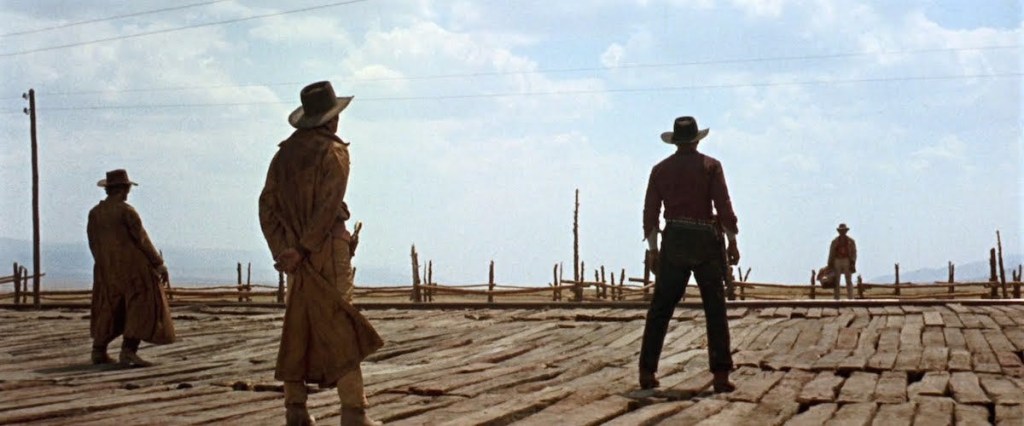
There are certain films that get better the more times they’re viewed. Once Upon a Time in the West not only falls into that category, but may honestly lead the pack. I don’t normally recommend it to most moviegoers—at least not at first. It’s extremely hard to fully appreciate its cinematic brilliance on a first viewing. Instead, you’re more likely to find yourself glancing at your watch, realizing just how unbelievably slow the movie is.
Are there pacing issues throughout this film? Absolutely (or at least to the novice popcorn muncher). However, the more seasoned film connoisseur will be utterly transfixed by Sergio Leone’s ability to turn a blank canvas into a beautifully framed piece of artwork with a camera. The story is rather simple: a mysterious harmonica player (Charles Bronson) joins forces with a desperado (Jason Robards) to protect a widow and her land from a hired gun (Henry Fonda) working for the railroad.
My View: Most critics say that if Clint Eastwood had signed on for one more film with Sergio Leone, Once Upon a Time in the West would have become their best collaboration. I think I’d have to agree. The film definitely stands on its own merits, but Charles Bronson is no Clint Eastwood. Henry Fonda, however, perfectly demonstrates his acting chops. Normally seen as an “everyman’s hero,” Fonda plays Frank with such ruthlessness that it is almost impossible to reconcile him with this sociopathic killer.
Best Line:
Frank: “How can you trust a man who wears both a belt and suspenders? The man can’t even trust his own pants.”
7. BUTCH CASSIDY AND THE SUNDANCE KID
Year Released: 1969
Director: George Roy Hill
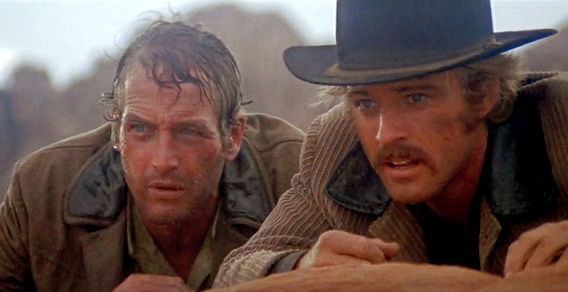
This was the western that introduced me to a much broader sense of not only what a western was, but what it could be. Butch Cassidy and the Sundance Kid starred Paul Newman and Robert Redford as the two historical figures whose misadventures were just as memorable as their accomplishments. After one too many train robberies, Butch and Sundance are pursued across what feels like half the country. In a desperate attempt to escape their ever-persistent posse, they leap off a cliff and eventually flee to Bolivia. Once there, they fall back into their old habits—with unfortunate consequences.
My View: The late sixties were filled with other counterculture, ultra-violent outlaw movies like The Wild Bunch and Bonnie and Clyde. Butch Cassidy and the Sundance Kid brought an entirely new spin to more than one genre, presenting the American public with a good-natured western that blended slapstick humor, traditional western action, and contemporary music—all while poking fun at western film clichés.
Best Line:
Butch Cassidy: “What’s the matter with you?”
Sundance Kid: “I can’t swim.”
Butch Cassidy: “Are you crazy? The fall will probably kill you.”
6. DANCES WITH WOLVES
Year Released: 1990
Director: Kevin Costner
Dances with Wolves is probably the most non-traditional western on my list. Non-traditional in the sense that it stands apart from the stereotypical Hollywood western of black hat-wearing antagonists and white hat-wearing protagonists. It was also the first time I truly remember seeing a film in which Native Americans were not portrayed solely as bloodthirsty savages and killers.
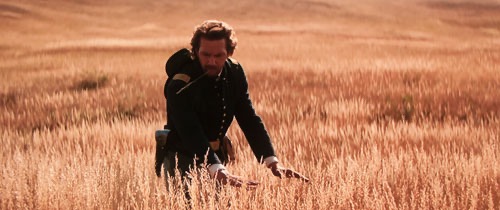
Lieutenant John Dunbar (Kevin Costner), in an attempt to end his life rather than lose his leg, unintentionally turns a stagnant Civil War battle into a Union victory. In return for his valiant efforts, he is treated by his general’s surgeon and awarded a posting at any U.S. Army outpost in the country. Dunbar chooses one on the unsettled western frontier. Unbeknownst to him, Fort Sedgwick has been abandoned by the Army. When he arrives, he finds a deserted base recently occupied by individuals who had apparently gone mad. After a few months, Dunbar comes into contact with the Sioux. He develops a wonderful relationship with them and eventually joins the tribe. He tells his entire story through the writing of his journal.
My View: Other than my atrocious summary of a four-hour movie (yes, the director’s cut really is that long), Dances with Wolves has not faded with time. The themes presented throughout the picture are just as hard-hitting today as they were when the film was released. It also shows how much the film industry has changed. This picture grossed over $180 million, but it took more than 50 weeks to do so. Can you imagine a picture staying in theaters for almost a full year? Not in this day and age.
Best Line:
[Dunbar has found an old skeleton on the prairie]
Timmons: “I’ll bet someone back east is going, ‘Now why don’t he write?’”
5. LONESOME DOVE
Year Released: 1989
Director: Simon Wincer
The only western listed here that was not actually released theatrically, Lonesome Dove was a miniseries that aired on CBS in 1989. This series introduced me to a far more story-driven western with wonderfully multi-layered characters. It did not thrive on moving from gun battle to gun battle, but rather on brilliantly written and executed dialogue.
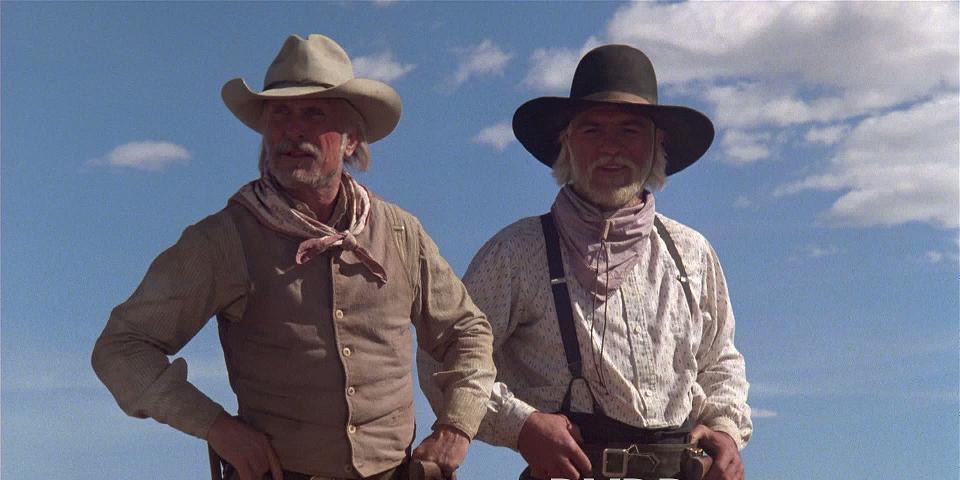
Augustus “Gus” McCrae (Robert Duvall) and Woodrow F. Call (Tommy Lee Jones) are two former Texas Rangers who run a cattle ranch in Texas near the border of Mexico. They decide to drive a herd of cattle north to Montana after a former comrade appears on the run for killing a mayor in Arkansas. The four episodes are beautifully woven around several supporting characters played by Danny Glover, Robert Urich, Diane Lane, Frederic Forrest, Rick Schroder, D. B. Sweeney, Anjelica Huston, Chris Cooper, and Steve Buscemi, among many others.
My View: I’ve never really placed this miniseries in the same category as other television dramas. The sheer talent of the cast alone elevates it above most miniseries from thirty years ago, let alone those made today. The producers set the bar so high with this series that every sequel that followed fell well short of this masterpiece.
Best Line:
Woodrow Call: “Well what does it say in Latin?”
[Gus blusters some gibberish]
Woodrow Call: “For all you know it invites people to rob us.”
Gus McCrae: “Well the first man comes along that can read Latin is welcome to rob us, far as I’m concerned. I’d like a chance t’ shoot at a educated man once in my life.”
4. UNFORGIVEN
Year Released: 1992
Director: Clint Eastwood
I remember the first time I saw this film. I was sixteen and went to the movies with my girlfriend and her family. I had never seen anything like it before and, to be completely honest, I didn’t really care for it. It was slow and boring (pacing has always been an issue for me with most Clint Eastwood-directed pictures). But most importantly, at that age, I didn’t understand the kind of film I was watching. It wasn’t like the other Clint Eastwood westerns I had grown up with. Once I got to college, I approached the film from an entirely new perspective.
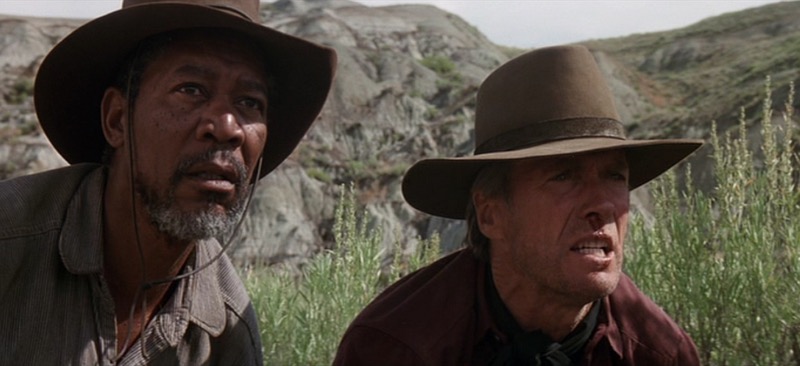
Clint Eastwood plays Will Munny, a retired gunslinger and murderer who changed his ways when he got married. He settled down, started a family, worked the farm, and eventually became a widower. He is approached by the Schofield Kid, a young and senseless gunfighter who has heard of Munny’s reputation. The Kid offers to split a $1,000 bounty for killing two men wanted for cutting up and beating a prostitute in Wyoming. At first, Munny declines, telling the Kid that his killing days are over. After reconsidering, he joins the Schofield Kid along with his former partner, Ned Logan (Morgan Freeman). The prostitutes reside in Big Whiskey, a town run by Sheriff Little Bill Daggett (Gene Hackman).
Little Bill, more than likely a former gunfighter, proves himself to be quite the corrupt lawman by the time Will Munny arrives in town. Munny, deathly ill by the time he reaches Big Whiskey, is harassed by Little Bill and his deputies. Little Bill wants nothing to do with any hired guns who have come to collect the bounty. The final act turns everything upside down. Munny decides to exact justice on those who run the town once Little Bill crosses the line, acting as Big Whiskey’s own judge, jury, and executioner.
My View: I never realized how a violent movie could also be an anti-violence film. But once I watched Unforgiven at an older age, I finally understood the point it was trying to make. Violence can be glamorized and romanticized to the point that killers are seen as heroes. By turning the tables on convention, the film opens your eyes to the gruesome reality that most certainly exists.
Best Line:
Little Bill Daggett: “Well, sir, you are a cowardly son of a bitch! You just shot an unarmed man!”
Will Munny: “Well, he should have armed himself if he’s going to decorate his saloon with my friend.”
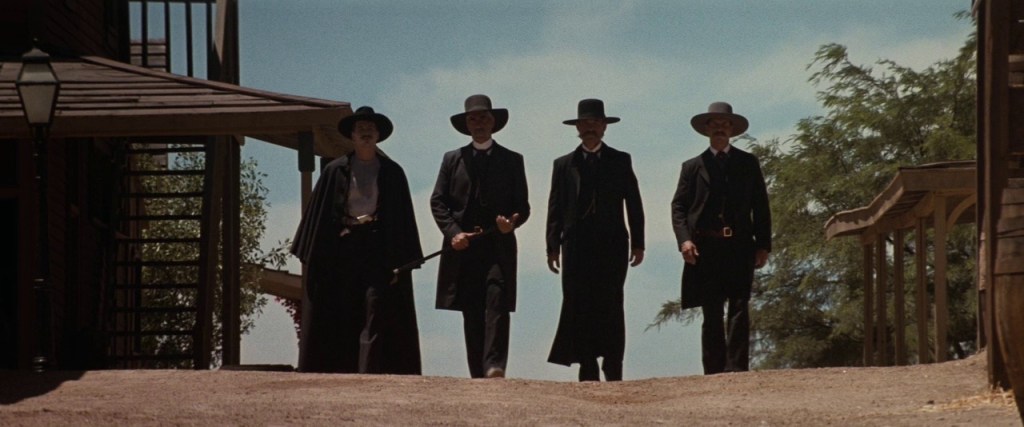
3. TOMBSTONE
Year Released: 1993
Director: George P. Cosmatos
While I did enjoy the more historically accurate Costner/Kasdan production of Wyatt Earp, Tombstone embodied the perfect Hollywood-stylized western of the modern era. Besides, of the two Wyatt Earp films released in the 1990s, Tombstone reached theaters six months earlier and actually turned a profit.
Tombstone tells the story of Wyatt Earp (Kurt Russell) and his brothers Virgil and Morgan (Sam Elliott and Bill Paxton), who move to Tombstone in pursuit of wealth. Upon their arrival, Wyatt is approached about taking a position in law enforcement. He declines, explaining that his family’s interests are to make money.
Throughout the first two-thirds of the film, Wyatt, his brothers, and his close friend Doc Holliday slowly but surely create conflict with “The Cowboys,” the gang that runs the town. A gunfight at the O.K. Corral later ensues, causing even more drama. After attempts on his brothers’ lives, as well as his own, Wyatt decides to exact justice by wiping the state clean of the Cowboys gang.
My View: Outside of a few silly moments—including one involving Kurt Russell yelling “No!” in slow motion before killing Curly Bill—the film holds up remarkably well for being fifteen years old. Tombstone pops with testosterone-filled dialogue that my friends and I still quote from time to time. It revitalized an almost dead genre when it hit theaters in 1993, and only a handful of films since its release can claim the honor of calling themselves westerns.
Best Line:
Wyatt Earp: “You gonna do somethin’? Or are you just gonna stand there and bleed?”
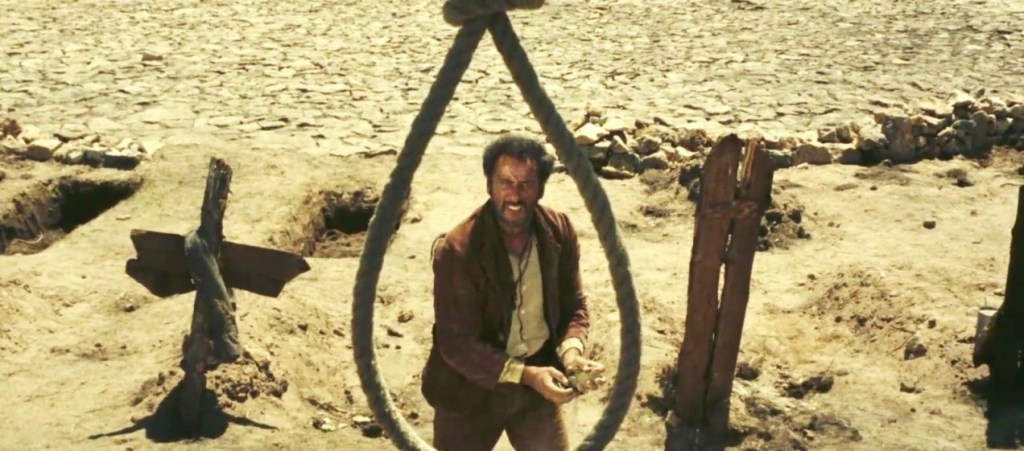
2. THE GOOD, THE BAD AND THE UGLY
Year Released: 1966
Director: Sergio Leone
the early 1960s, Sergio Leone wanted to remake the classic Akira Kurosawa samurai film Yojimbo. This wasn’t the first time someone had reworked a Kurosawa story (The Magnificent Seven was a remake of Seven Samurai). Luckily for Leone, he had two things in his favor: (1) samurai films translate naturally into westerns, and (2) The Magnificent Sevenhad been a theatrical success. So, after A Fistful of Dollars became the first spaghetti western to receive a major international release, two sequels quickly followed.
Considered one of the greatest westerns ever made by critics and moviegoers alike, The Good, the Bad and the Ugly is the third and final film in Sergio Leone’s “Man with No Name” trilogy. Clint Eastwood perfects the role here, playing many of his scenes opposite Tuco (Eli Wallach), who refers to him as “Blondie.” The film opens with Blondie rescuing Tuco from a hanging. Tuco, with several bounties on his head, makes a deal with Blondie to have himself turned in, and right before he is hanged, Blondie “releases” him from the rope around his neck. They split the bounty afterward, going from town to town repeating the scam. When their strained relationship begins to sour, Blondie leaves Tuco to fend for himself in the desert.
Tuco escapes the desert and is hell-bent on turning the tables on Blondie. Before he can abandon Blondie there, they come across a runaway stagecoach carrying both dying and dead Confederate soldiers. The situation changes when a dying soldier asks for a drink of water in exchange for the location of buried gold in a cemetery. Before he dies, he whispers in Blondie’s ear which grave holds the gold.
Tuco spends the rest of the film helping Blondie recover from the torturous desert and then traveling with him across the country in search of the cemetery. Along the way, they cross paths with a cold-blooded killer named Angel Eyes (Lee Van Cleef), who has also learned of the buried gold. The final act ends with one of the most brilliantly filmed gunfight standoffs in cinematic history.
My View: Sergio Leone created his greatest western here, even though he went on to make a few more after Clint Eastwood declined additional offers. Eastwood had already made a name for himself by the film’s release—something uncommon for most spaghetti western stars—and was able to ride the coattails of its success. With its signature close-ups, unforgettable score, and morally ambiguous characters, the film captured everything that most Hollywood-produced westerns had failed to achieve in the previous two decades. It has since influenced a whole new generation of filmmakers and continues to inspire today.
Best Line:
Man With No Name: “You see, in this world there’s two kinds of people, my friend: Those with loaded guns and those who dig. You dig.”
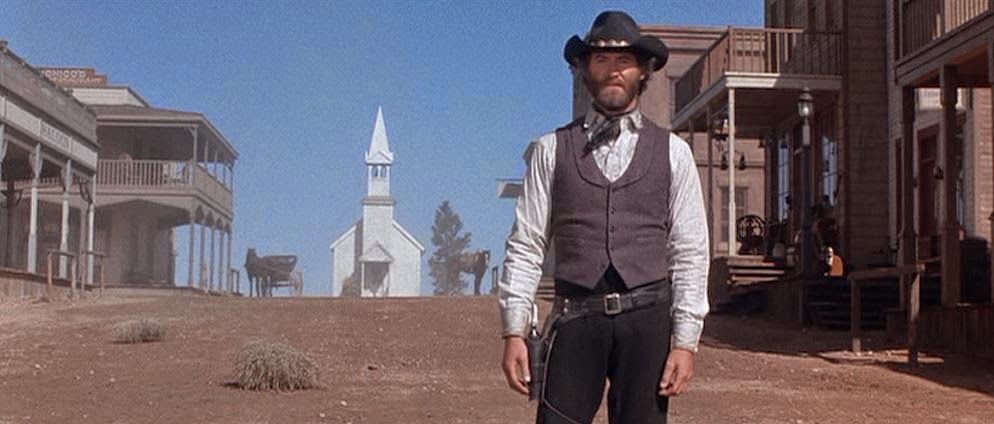
1. SILVERADO
Year Released: 1985
Director: Lawrence Kasdan
It’s hard to believe this film was released in the 1980s. It felt completely unconventional for its time. What I find even more amazing is that, after all these years, it still holds up remarkably well.
Silverado opens with a beautifully choreographed gunfight. Emmett (Scott Glenn), asleep in his tiny shack, is visited by three men intent on killing him. Once he disposes of them, he heads out to find his younger brother. Along the way, he comes across Paden (Kevin Kline), who seems to have been left for dead in the desert. Emmett befriends Paden, and they ride into the next town, where they encounter Mal Johnson (Danny Glover), who is being harassed in a saloon because of the color of his skin. After Mal is asked to leave town, Emmett discovers that his brother Jake (Kevin Costner) is scheduled to be hanged the next morning. Jake claims self-defense, but the sheriff replies, “The jury saw it differently.” Emmett breaks his brother out of jail the next morning, and along with Paden and Mal, they head to Silverado to see their sister before moving to California.
Once in Silverado, the four protagonists find themselves in their own predicaments. Emmett and Jake run into trouble with a wealthy rancher and landowner named McKendrick. Mal visits his father, who has been pushed off his land by McKendrick, while Paden discovers that the men who left him for dead in the desert are now the lawmen running Silverado. The final act brings them together to free the town from a ruthless landowner and the corrupt lawmen on his payroll.
My View: Silverado, to me, embodies the perfect western film: a great story, an ensemble cast, gorgeous scenery, a roaringly good score, efficient editing, and multi-layered yet moral protagonists, all brought to life through brilliant direction. To quote my wife, “Re-watching this film is like having old friends over to visit.” That is exactly how I feel about this film, and why it has become increasingly difficult to find a western that can knock it down from the number one slot.
Best Line:
Mal Johnson: “Now, I don’t wanna kill you, and you don’t wanna be dead.”
Until next time, dear readers.


Leave a Reply