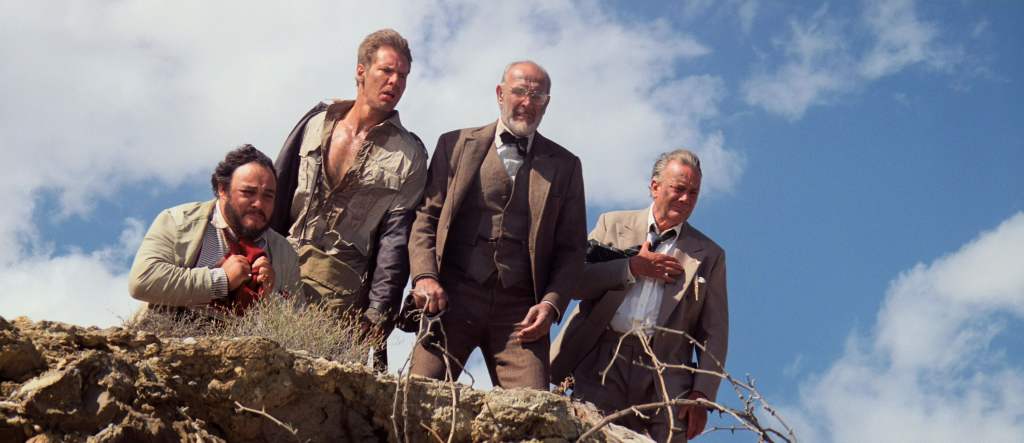
“That belongs in a museum!”
Directed by Steven Spielberg
Produced by Robert Watts
Written by Jeffrey Boam
Story by George Lucas, Menno Meyjes
Release Date: May 24, 1989
Running Time: 127 Minutes
THE COLD OPEN
This is Indiana Jones’ origin story. If you ever wanted to know why Indy is the way he is, The Last Crusade puts it all right there on the screen in what is easily the second-best cold open of the franchise—though it’s always fighting for first place.
As the Paramount logo dissolves into a nearly identical rock formation somewhere in what we all know is basically Monument Valley, we’re introduced to Indiana Jones… the Boy Scout.
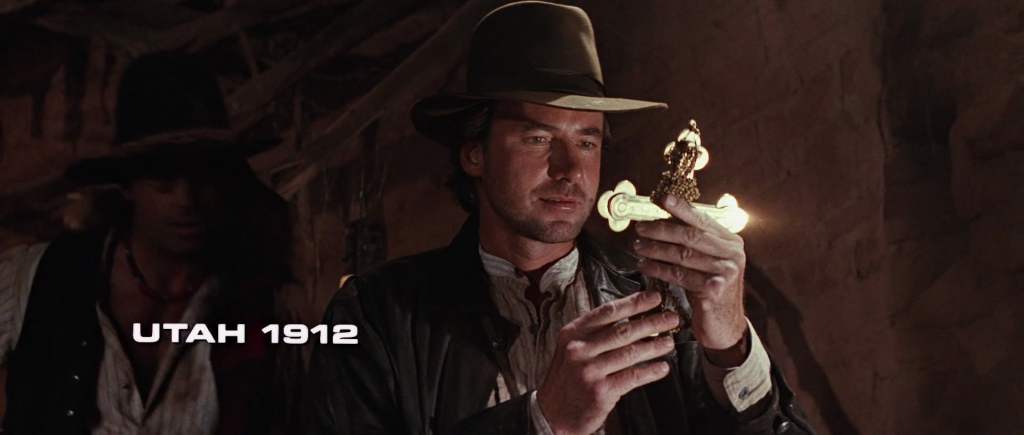
The year is 1912. The place is Utah. During a cave exploration, a teenage Indiana Jones, played brilliantly by River Phoenix, stumbles onto grave robbers looting the Cross of Coronado, a priceless artifact he immediately decides “belongs in a museum.” After stealing it back, he’s chased by an eclectic crew of mercenaries—led by a guy who suspiciously looks like Indy twenty years older and already wearing the hat, plus one screaming redhead obnoxious enough to earn the Willie Scott Memorial Award for Most Annoying Glorified Extra in a Cold Open.
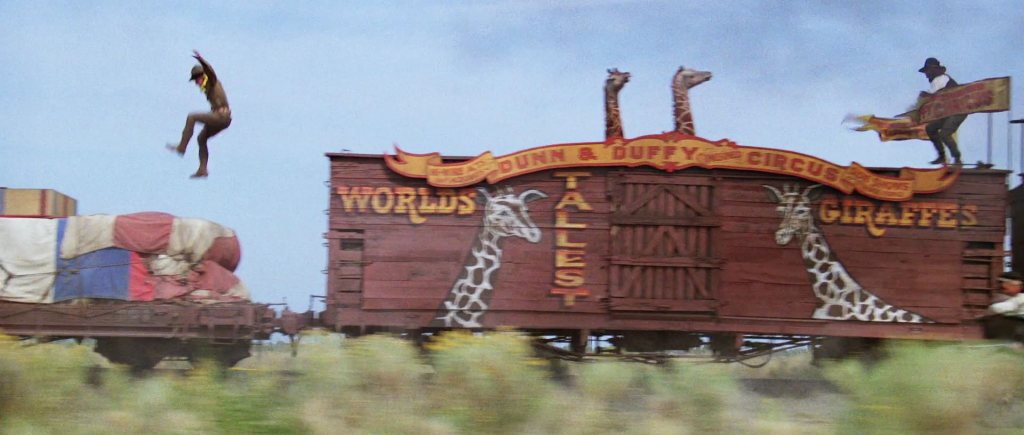
The chase spills onto a circus train, and in the span of about ten minutes, Indy picks up nearly every defining trait that will follow him into adulthood: the fedora, the whip, the scar on his chin, and a lifelong fear of snakes.
And that’s what makes this opening so good. It’s not just an origin story—it’s a blueprint. It shows us Indy’s moral code from the jump. Priceless artifacts aren’t meant to be looted and sold off to the highest bidder. History matters. Preservation matters. And sometimes, as Indy will spend his whole life proving, obsession matters a little too much.
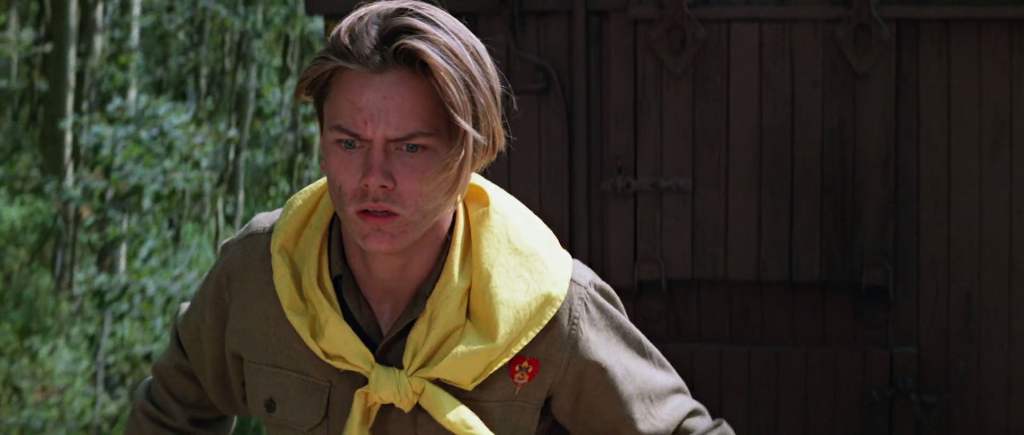
It also quietly tells us everything we need to know about his relationship with his father. When Indy rushes home expecting help, Henry Jones Sr. barely looks up from his Grail research long enough to tell him to count to twenty in Greek. By the time he’s finished, the sheriff, the Boy Scouts, and the mercenaries have all arrived at their front door, and the Cross is handed right back over to its buyer—Panama Hat.
But before they leave, after Indy loses and after his father dismisses him, the mercenary leader gives him the fedora and a piece of advice that he will carry for the remainder of his life:
“You lost today, kid… but that doesn’t mean you have to like it.”
It’s a strange little passing of the torch, but it works.
Then the film smash-cuts to adult Indy, now somewhere off the coast of Portugal and, as usual, is in another pickle. He’s tracked down Panama Hat twenty-six years later aboard the Vasquez de Coronado and is trying to reclaim the Cross once again. Fists fly, giant waves crash over the deck, and Indy barely escapes with his life, floating in the ocean as the freighter explodes and sinks into the distance.
Because apparently some lessons take a lifetime to stick.
THE STORY
Indy is back, and since it’s only been two years since the events of Raiders of the Lost Ark, so are the Nazis. Which is fine, because Indiana Jones punching Nazis just feels right. Like peanut butter and jelly. Or getting punched in the face if you’re a Nazi.
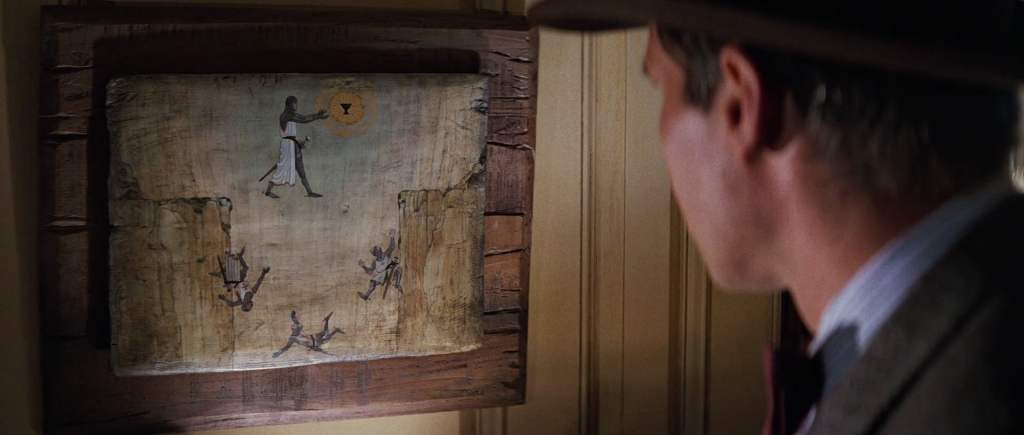
The year is 1938, and while Indiana Jones is buried under classes, papers, and a curriculum that probably hasn’t seen his full attention in months, he does what any responsible professor would do when faced with a swarm of eager students: climbs out the window and disappears.
Waiting on the other side is Walter Donovan, the wealthy patron funding Henry Jones Sr.’s search for the Holy Grail, who arrives with troubling news: Indy’s father has gone missing. Worse, so has his Grail Diary—the blueprint to a lifetime of obsession.
That’s all Indy needs. Semester be damned.
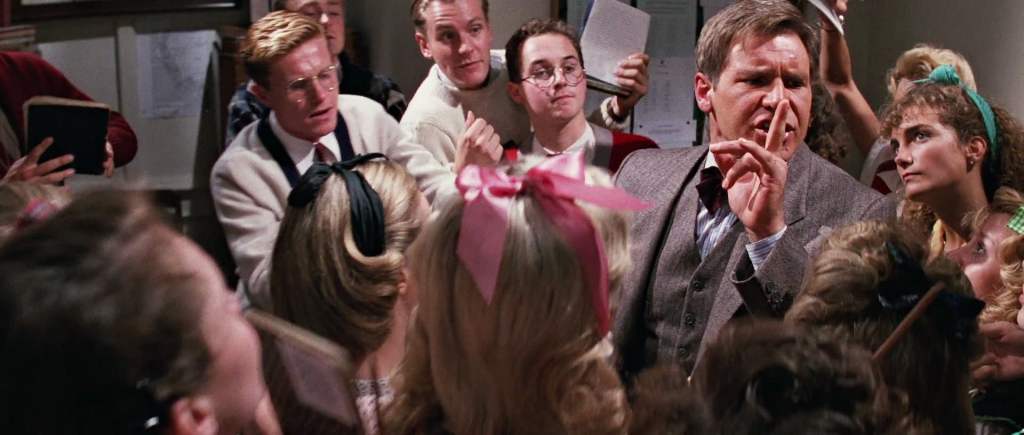
With Donovan bankrolling the rescue and pointing him toward Venice—the last place Henry was seen—the search quickly opens into catacombs, crypts, castles, Nazis, betrayal, and eventually the path to the Grail itself.
But like Last Crusade does so well, the Grail is only part of the story.
At its core, this isn’t really about eternal life or uncovering the greatest relic in human history. It’s about a son chasing after his father—physically, emotionally, and spiritually—while slowly realizing just how much of the old man is already living inside him.
And that’s where the title does double duty. On the surface, it’s an obvious nod to the historical Crusades fought over the Holy Land. But by definition, a crusade is also a zealous pursuit of something deeply important. In that sense, this isn’t just the last crusade for the Grail. It’s Indy’s last crusade with his father.
THE VILLAIN
Julian Glover plays the ally-turned-villain Walter Donovan, which is funny considering he’d already played an ally-turned-villain eight years earlier in For Your Eyes Only. And when you find an archetype that works, I guess you stick with it.
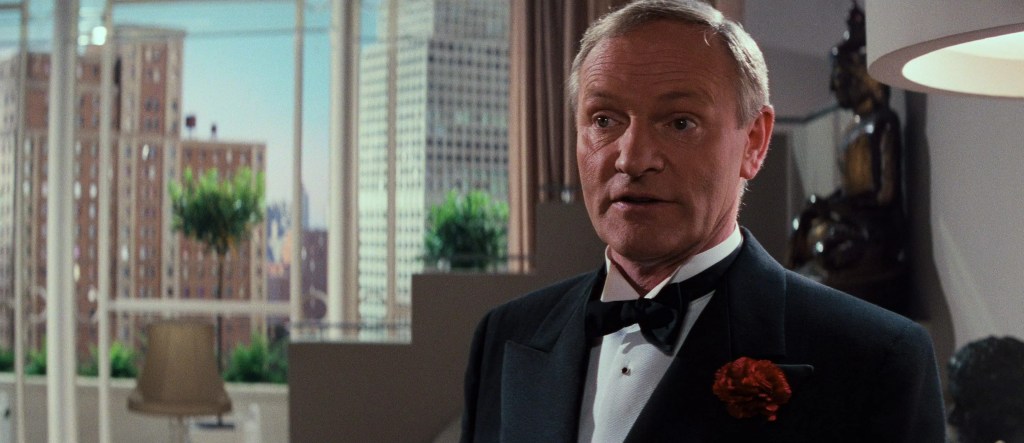
Donovan is essentially the wealthy industrialist version of René Belloq, only without the academic background or archaeological pedigree. Like Belloq, he’s fascinated by ancient relics with supernatural implications. And like Belloq, he’s more than willing to ride alongside the Nazis if it gets him what he wants. Which, by 1938, should’ve been enough of a red flag for everyone involved considering how things went the last time Indy crossed paths with Hitler’s occult enthusiasts. But that’s material probably better suited for The Field Notes.
What separates Donovan from Belloq, though, is motive. Belloq wanted discovery. Donovan wants immortality.
That’s his endgame. Eternal life. No matter the cost. No matter how many bodies pile up in his wake, whether by his own hand or by proxy through his cozy little arrangement with the Third Reich. And that’s what makes him dangerous. He doesn’t just want to find the Holy Grail—he wants to drink from it.
What also makes Donovan effective is how convincingly he presents himself as an ally first. He bankrolls Henry Jones Sr.’s Grail quest, funds Indy’s rescue mission, and never once tips his hand until it’s far too late. You’d think Indy’s instincts might’ve kicked in a little sooner. After all, when a man with that much money starts throwing it around in pursuit of eternal life, odds are he’s not on the right side of history.
And in the end, that’s what makes Donovan work so well. He isn’t chasing the Grail to preserve history, understand it, or protect it. He wants to conquer death itself. Belloq wanted to possess the power of God. Donovan wanted to consume it. And in classic Indiana Jones fashion, that turns out to be a very bad idea.
THE HEAVY
While Major Arnold Toht was just a sadistic Gestapo agent, Colonel Vogel is the physical embodiment of Nazi efficiency—less creepy, more practical, and somehow just as cruel.
Vogel, played with ruthless precision by Michael Byrne, is the kind of Nazi who skips the speeches and gets straight to the punching, which makes him an effective Heavy in the purest sense of the word: he exists to make things harder—if not nearly impossible—for our hero… or heroes, in this case.
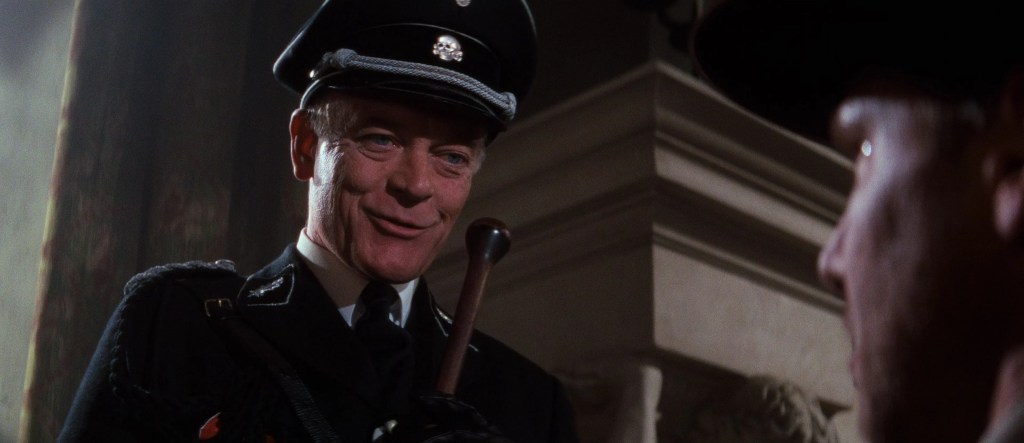
Vogel is a die-hard SS officer who doesn’t mind getting his hands dirty whenever the opportunity presents itself. He doesn’t just pursue Indy and his father—he hunts them. He oversees brutal interrogations, torture, and more than a few beatings, all while looking like he’s enjoying every second of it.
And like any good Heavy, his relentless pursuit eventually leads to one of the greatest action sequences in the entire franchise: the tank chase. Which also, fittingly enough, is where Vogel finally meets his end.
THE LOVE INTEREST
Elsa Schneider is the classic double-agent love interest that absolutely nobody saw coming. Or at least I sure as hell didn’t when I was thirteen years old, sitting in a darkened theater and completely distracted by her blonde hair, ruby lips, and stunningly beautiful… blue eyes. Yeah. Her blue eyes.
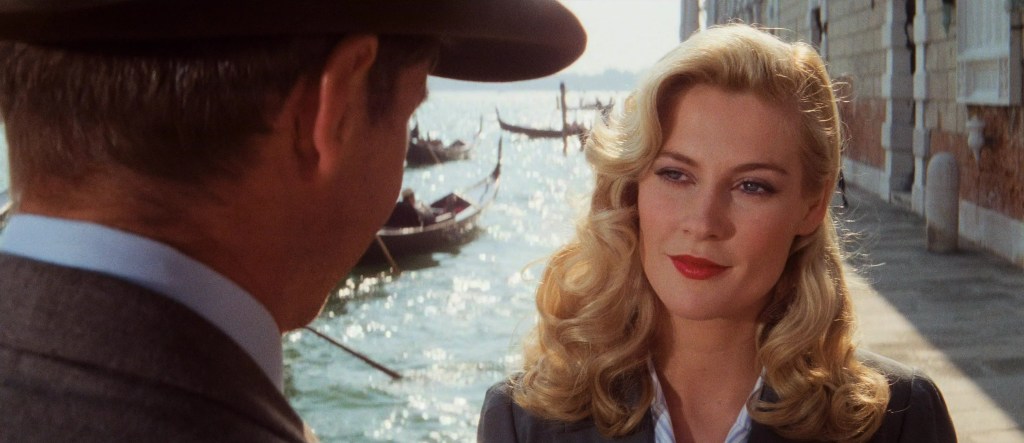
Portrayed by Alison Doody—whose feature film debut came in A View to a Kill because apparently this movie can’t stop tripping over James Bond connections—Elsa is very much an equal to Indiana Jones. She’s an Austrian archaeologist, intelligent, capable, and every bit as obsessed with history and discovery as Indy is. At least, that’s how she presents herself.
Unfortunately for Indy, she’s also in lockstep with the Nazis. Which, in hindsight, probably should’ve been his first clue. But who’s checking internal red flags when you’ve got Elsa on your arm, fighting off rats in Venetian catacombs and trying to stay one step ahead of the Brotherhood of the Cruciform Sword?
And if there were warning signs going off, Indy was completely blind to them. And honestly, who can blame him? The odds of hearing her casually slip into German in her sleep after everything they went through in Venice were probably pretty slim. Or his dad was probably just a light sleeper.
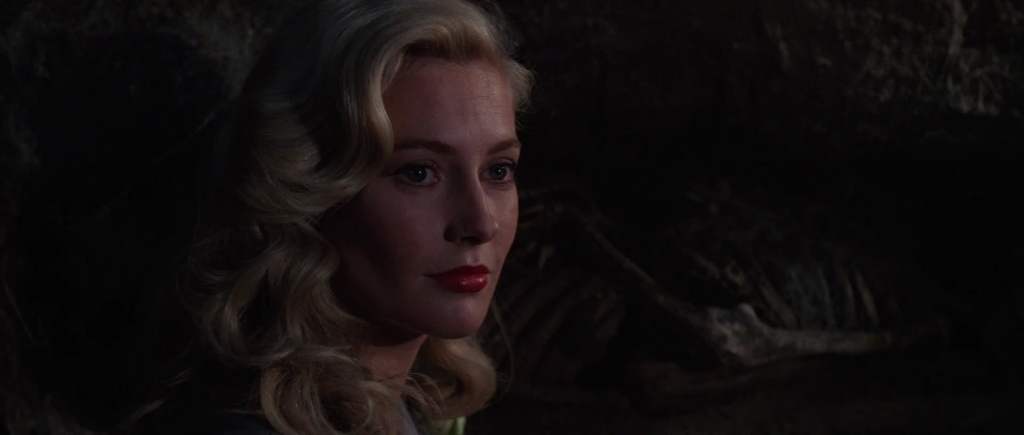
Elsa works so well here partly because Alison Doody is giving a far better performance than Kate Capshaw ever did in Indiana Jones and the Temple of Doom. But more importantly, Elsa is designed to be a distraction. Not just romantically, but ideologically. She’s the kind of person Indy could easily become if he ever let obsession outweigh principle.
And that’s what makes her dangerous. Because with Indy, there always seems to be a woman waiting somewhere around the next corner. The difference here is that this one wasn’t just after his heart. She was after the Grail, too. And unlike Indy, she was willing to reach a little farther for it.
THE FEDORA REPORT
LIKE SENIOR, LIKE JUNIOR
For all the adventure Last Crusade throws at us, the real excavation here is the relationship between Indy and his father—or more accurately, the lack of one.
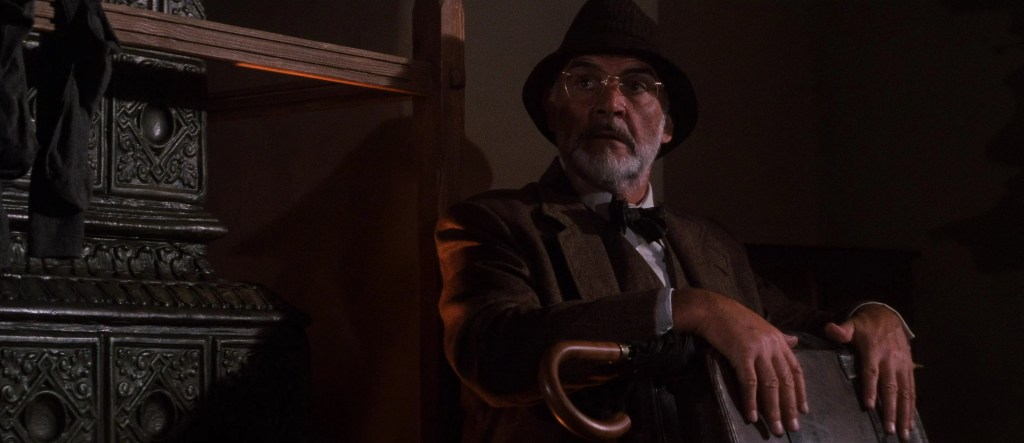
Henry Jones Sr., portrayed by Sean Connery—yes, James Bond himself—feels like one of those rare pieces of casting so perfect it almost seems inevitable. Connery somehow feels like he was born to play Indiana Jones’ father.
And Henry wasn’t absent in the traditional sense. He was there. Or at least we’re supposed to assume he was. Somewhere in the house. Maybe at the local public library—whatever that even looked like in Utah in 1912. Usually buried in books, notes, and Grail lore.
But emotionally? He may as well have been on another continent… or trapped behind a giant boulder in some ancient temple—which we all know Henry was never nimble enough to outrun.
The opening in 1912 tells you everything you need to know. Indy comes home shaken, desperate to tell his father what happened, and Henry barely looks up. Instead of comfort, he gets told to calm down and count to twenty in Greek—which, judging by Indy’s face, does not go over well.
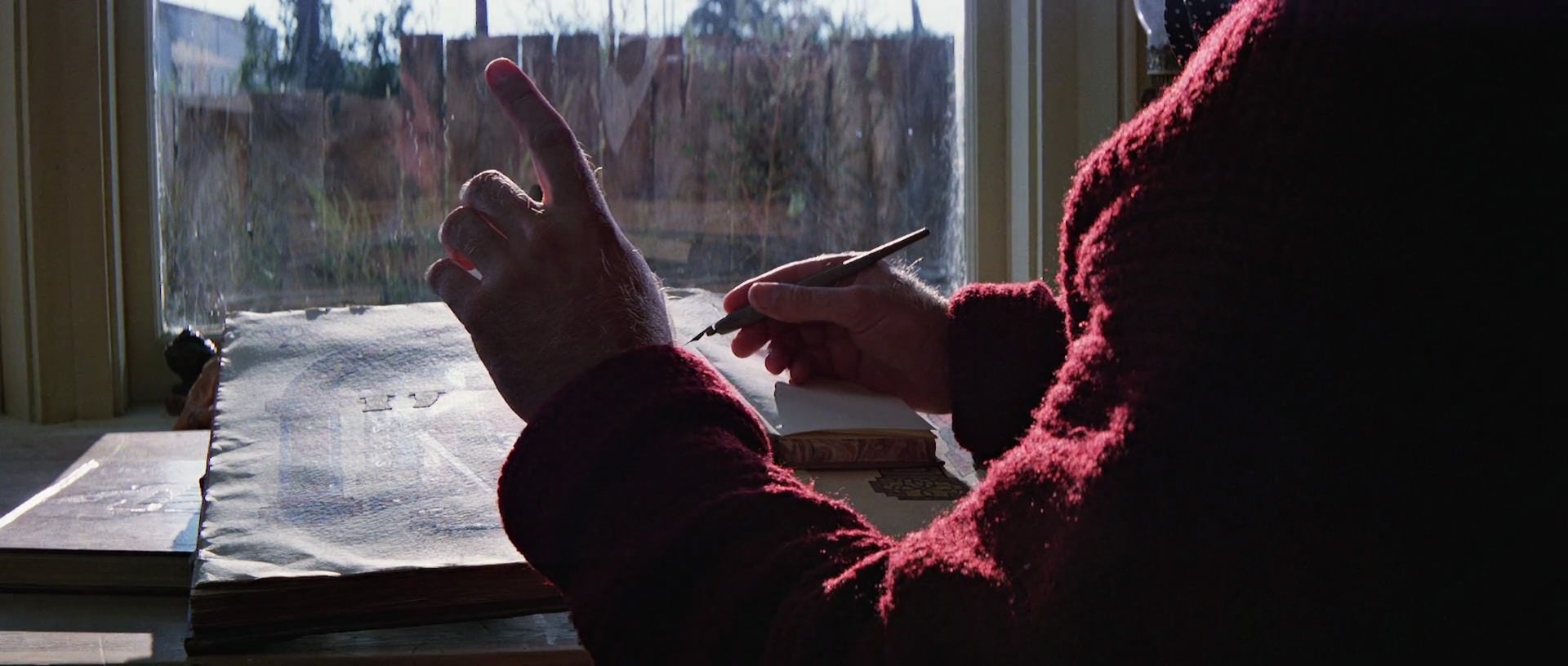
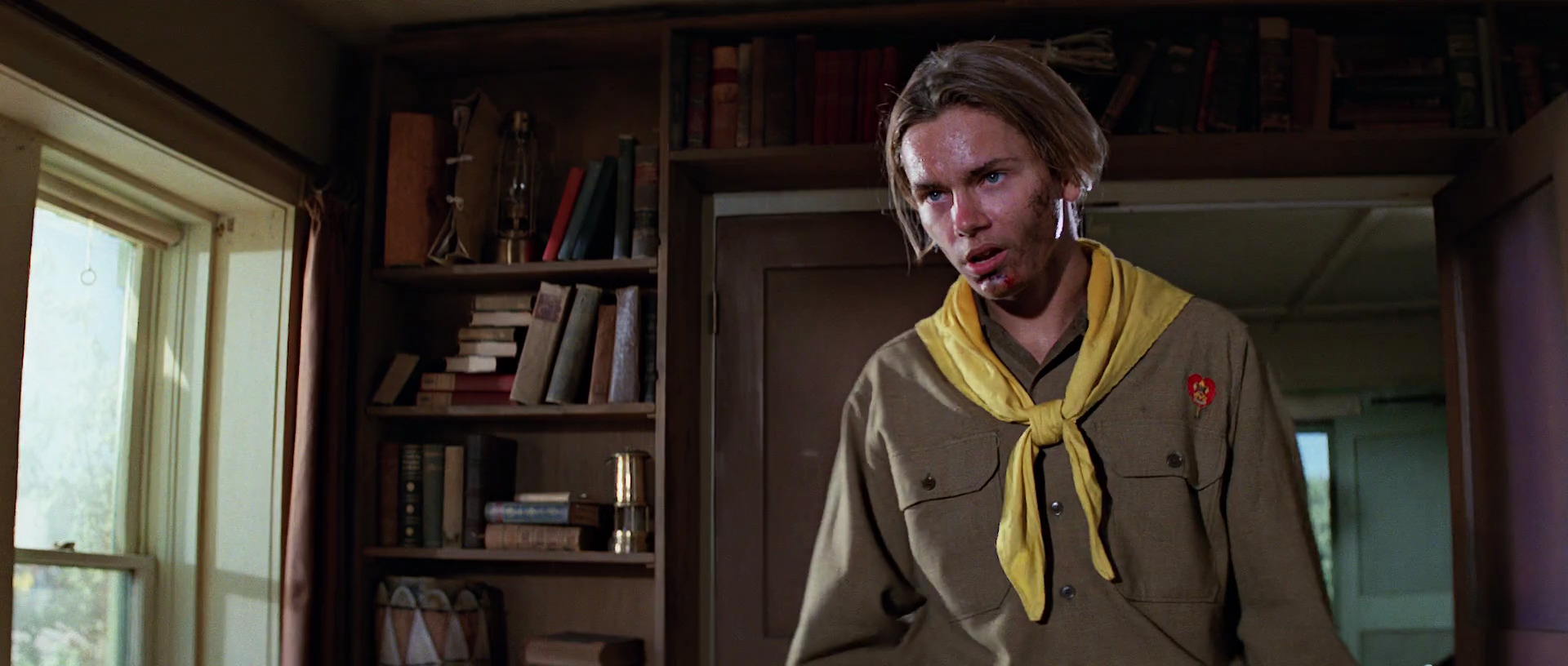
And the uncomfortable truth is… Indy grows up to become a lot like him.
His office is a graveyard of artifacts, unfinished work, and neglected responsibilities. His life is dictated by obsession, just like Henry’s was. The difference is that Indy filled that void by chasing things that mattered to him, while Henry spent his life chasing something that mattered more than his son.
The difference is that Indy spends most of this movie either being told directly or realizing himself how much he’s become like his father, while Henry mostly brushes it off. Is Henry concerned about his son’s wellbeing after Indy smashes a vase over his head? Not really. He’s more concerned about whether the vase was a priceless artifact.
And almost immediately after that, Henry keeps calling him Junior, never really understanding how much that bothers him. It isn’t until they’re standing in a room full of Nazis, arguing over why he brought the Grail Diary right back into the clutches of the enemy, that it finally boils over. Indy grabs a machine gun, unloads on some guards, and snaps back with a furious, “Don’t call me Junior!”
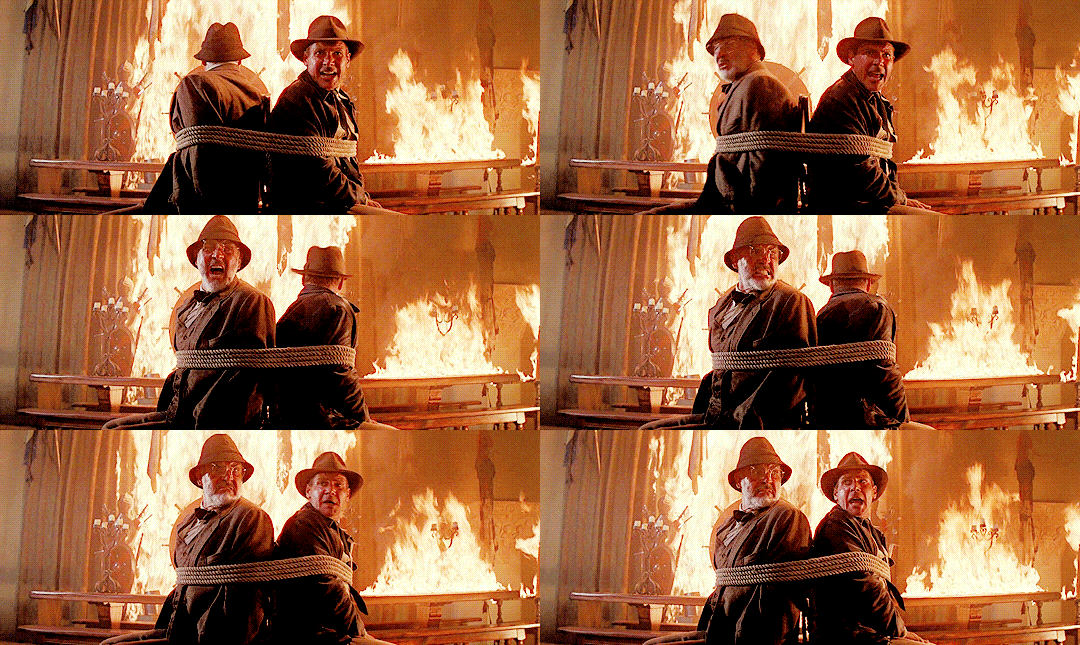
And Henry’s reaction says everything. He’s stunned. Not because his son is angry—but because for maybe the first time, he’s seeing exactly who his son has become. This isn’t the frightened kid who came running home in 1912. This is a man who punches Nazis, shoots his way out of impossible situations, and somehow survives them all.
Henry spent years studying history. But he never really took the time to know his own son. And even after that moment, he keeps calling him Junior anyway. Partly because it’s funny. Partly because the audience needs the laugh. But mostly because some distances take longer to close than others.
But then something shifts on the Zeppelin. For maybe the first time in Indy’s life, Henry stops. He puts the diary down. He listens. And Indy doesn’t know what to do with it.
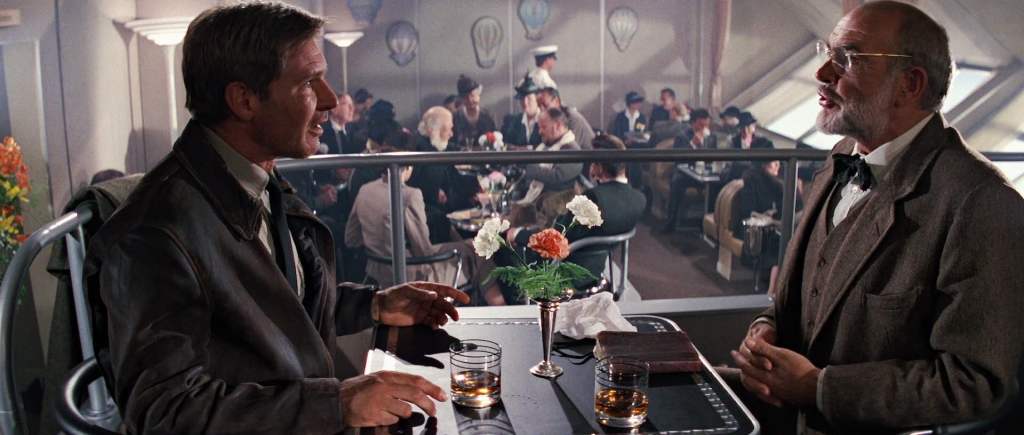
He goes silent. Swallows it all down. He allows his father to change the subject. Why? Because by then, the space between them has been there for so long it’s just a part of who they are.
That’s what makes their relationship so compelling. This isn’t just a rescue mission. It’s a son chasing after the father who spent his whole life chasing something else.
And in the end, when Henry finally tells him to let the Grail go, it’s the first time in the entire movie he chooses his son over the thing he spent his life pursuing. It only took a lifetime—and the edge of a bottomless pit—but he got there.
THE PROFESSOR’S TOMB
If I had to guess, sitting on his desk, in no particular order, are two university memos, a donor request, three invitations to guest lecture, twelve letters from students begging for extensions, and one envelope stamped URGENT: Department Chair—which, judging by the dust on it, has probably been sitting there since last May.
It’s also a pretty clear indication that Indiana Jones’ office looks less like a professor’s office and more like a storage closet the university reluctantly let him occupy.
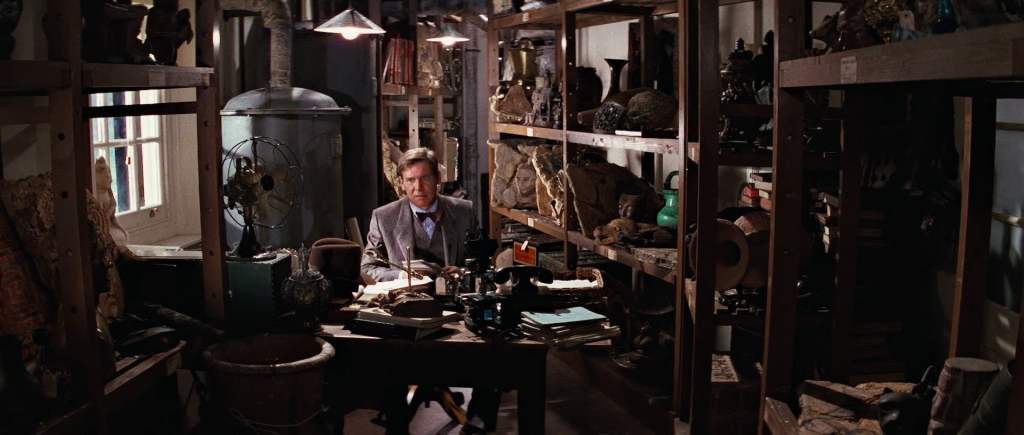
One of Last Crusade’s most underrated achievements is how much of Indiana Jones’ life is told through the rooms he occupies. His office isn’t really an office—it’s an archaeological overflow bin, a museum annex, and a graveyard for ungraded term papers all crammed into one space. It’s covered in the residue of his field life, a clear sign that by this point Professor Jones and Indiana Jones have stopped being separate people. Every artifact on those shelves feels like evidence from adventures we’ll never see. It’s less an office and more of a tomb, really—and if they buried Indy in there, give it a thousand years and he’d probably end up in a museum.
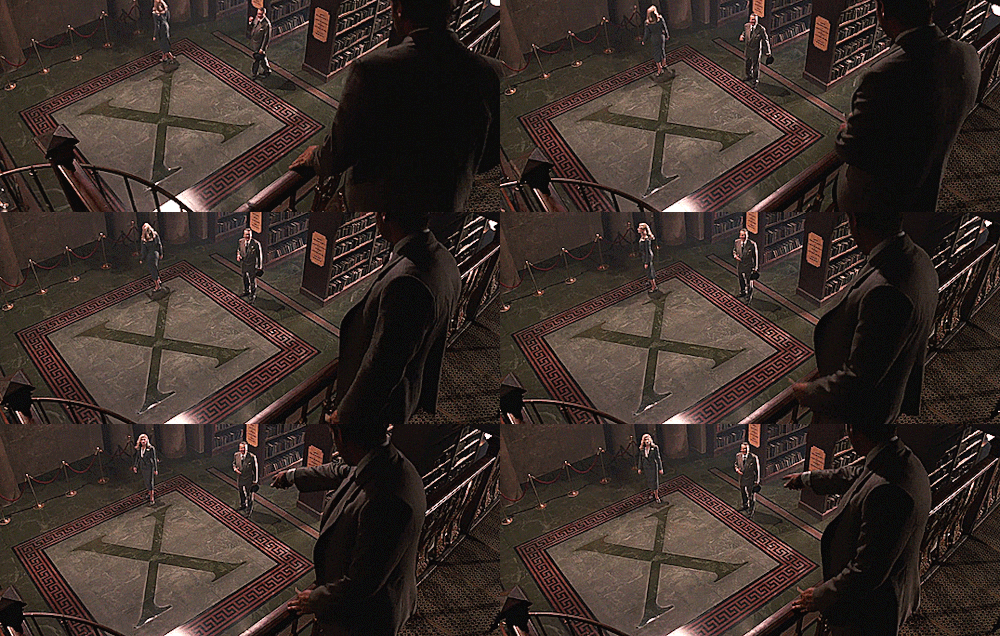
SPIELBERG’S FINGERPRINTS
REFLECTIONS
Throughout his career, Steven Spielberg has always had a thing for reflections. It goes all the way back to Duel, where he used mirrors and reflections to frame the truck as this looming, ever-present threat. From there, it became one of his quiet little trademarks—usually a sideview mirror, sometimes something else, but almost always there if you’re paying attention.
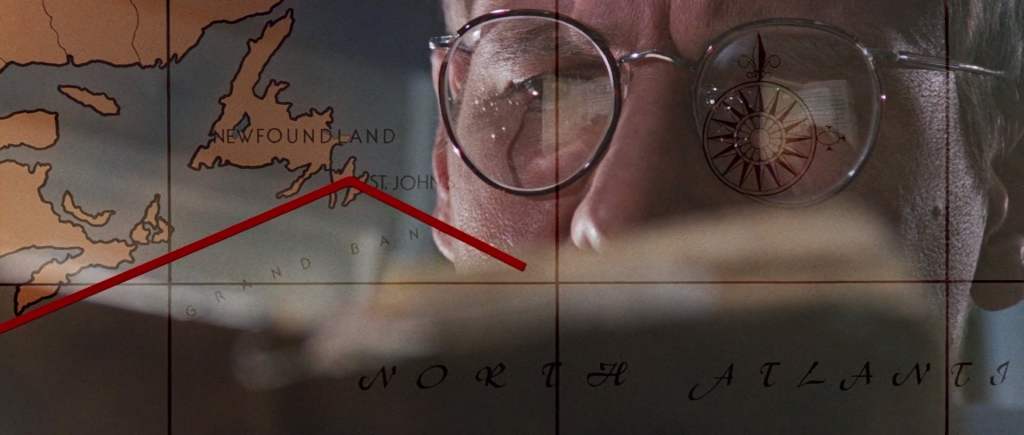
The shot above is a much subtler version of that. As the map is superimposed over the screen and Indy studies his father’s Grail Diary, Spielberg catches the reflection of the diary in the lens of Indy’s glasses. It’s a small detail, but it says a lot. Indy isn’t just following clues here—he’s literally seeing the world through his father’s obsession.
THE SPIELBERG FACE
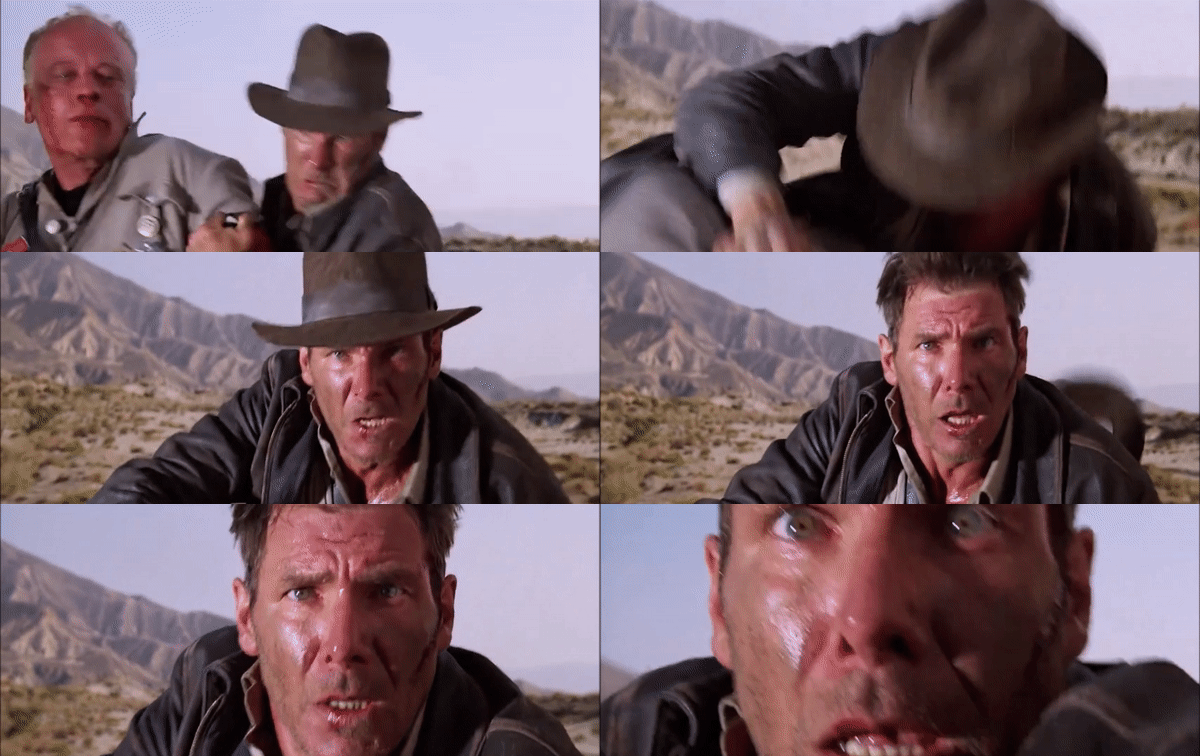
I already broke down The Spielberg Face back in my Raiders post, so I won’t spend too much time rehashing it here. But Indy’s expression in this moment—realizing he’s still stuck on a tank that’s seconds away from going over a cliff—is about as self-explanatory as it gets. It’s the universal face of a man doing the math in real time and not liking the answer.
THE FRACTURED FAMILY DYNAMIC
Another recurring theme Spielberg often weaves into his films is the fractured family dynamic. Whether he’s consciously writing it in or subconsciously exploiting it because of his own childhood, it’s there—and once you start looking for it, it’s hard to miss.
You can trace it back as early as The Sugarland Express, but it’s all over Close Encounters of the Third Kind, E.T. the Extra-Terrestrial, Hook, Catch Me If You Can, and even War of the Worlds—and that’s just scratching the surface if you keep excavating Spielberg’s career. Fathers leaving. Parents splitting. Children caught somewhere in the emotional wreckage.
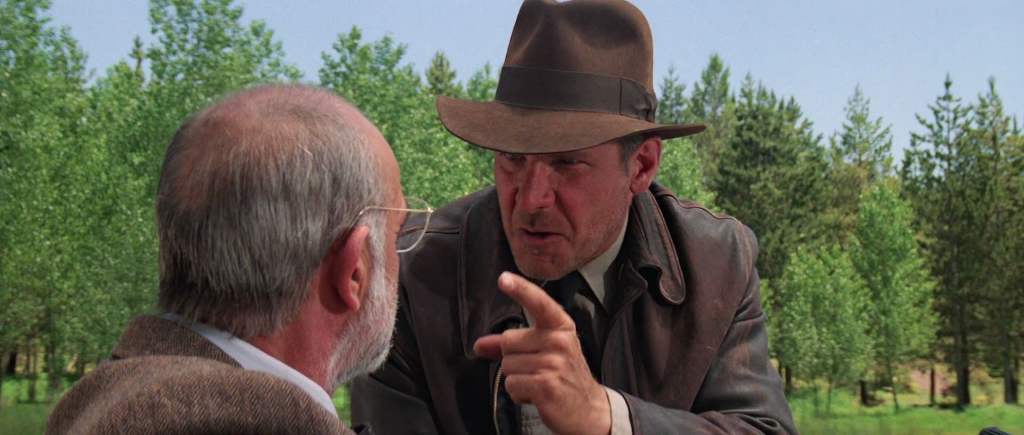
And in Indiana Jones and the Last Crusade, that fracture is right at the center of the story. For all the Nazis, Grails, and ancient traps, this is still a movie about a father and son trying to figure out how to speak to each other after years of not really trying. Spielberg may dress it up as adventure, but the wound underneath is always family.
THE TECHNICALS
BEST QUOTE
At the height of our heroes’ increasingly desperate attempt to survive, this exchange between Indy and his father is the perfect example of how Indiana Jones and the Last Crusade knows exactly when to inject humor into the chaos.
Indiana Jones: Come on, Dad. Help me get us out of here. We have to get to Marcus before the Nazis do.
Professor Henry Jones: But you said he had a two-day head start. That he would blend in, disappear.
Indiana Jones: Are you kidding? I made all that up. You know Marcus. He once got lost in his own museum.
It’s one of the funniest lines in the whole movie, and it lands even harder because Henry clearly doesn’t know Marcus well enough to realize Indy is completely full of it. Which, if we’re being honest, tracks. With how often Henry was off filling in another chapter of his Grail Diary, Marcus probably spent more time being a surrogate father to Indy than Henry ever did.
BEST FIGHT
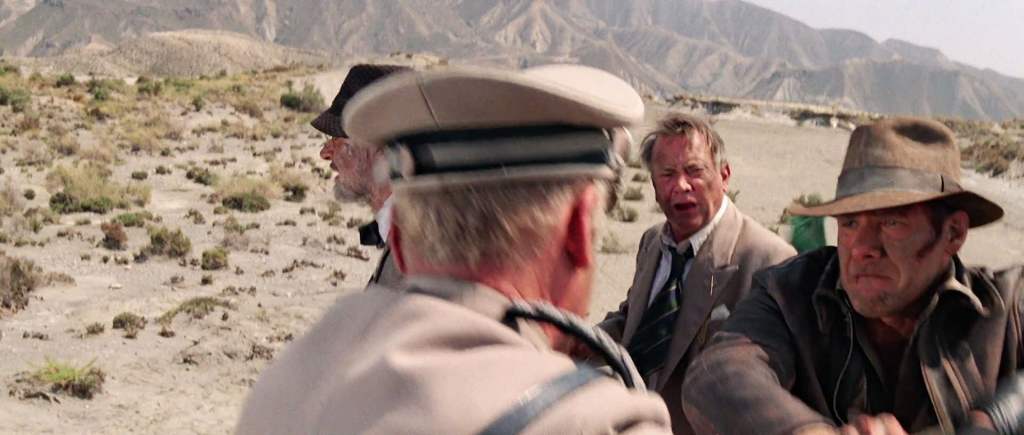
I don’t know if it’s entirely fair to pull a fight sequence out of the middle of the tank chase, but I’m doing it anyway. By this point, Henry and Marcus have finally managed to get out of the belly of the steel beast, while Indy—like he’s working his way through a video game level—has fought his way through what feels like every Nazi on board and reached the final boss: Colonel Vogel.
Marcus asks, “How does one get off this thing?”
Before anyone can answer, Indy pulls back for one of his signature telegraphed punches, and before his fist can move forward into Vogel’s ugly mug… he accidentally knocks Marcus clean off the tank.
It’s one of those perfect Indiana Jones moments. A tense, brutal fight scene suddenly undercut by a perfectly timed joke. Once again, Last Crusade knows exactly when to let some air out of the balloon before tightening it right back up again.
BEST ACTION SEQUENCE
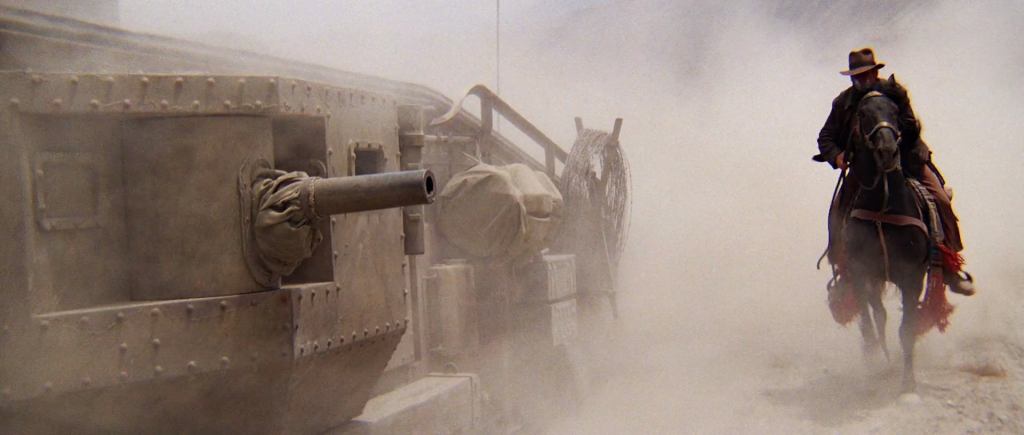
Best Action Sequence? Come on. It’s the tank chase. This isn’t even up for debate. If you think it’s anything else, I can only assume you either fell asleep, left the room, or accidentally started watching Crystal Skull.
BEST SINGLE FRAME
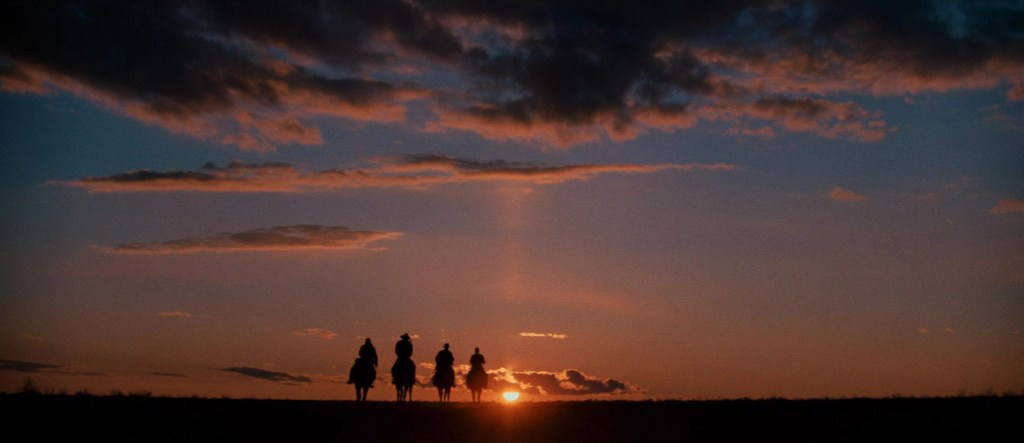
I guess Spielberg picked up a thing or two from John Ford when framing this final shot. I can’t help but wonder if he had that lesson rattling around in his head when he and Douglas Slocombe lined it up, with only a few precious minutes of sunlight left before the day was gone. If you’re not sure what I’m getting at, watch the clip below from The Fabelmans. Trust me, it’ll click.
BEST CALLBACK
There are probably other callbacks to Raiders scattered throughout Last Crusade, but this one—while completely on the nose—is still my favorite. And probably yours, too.
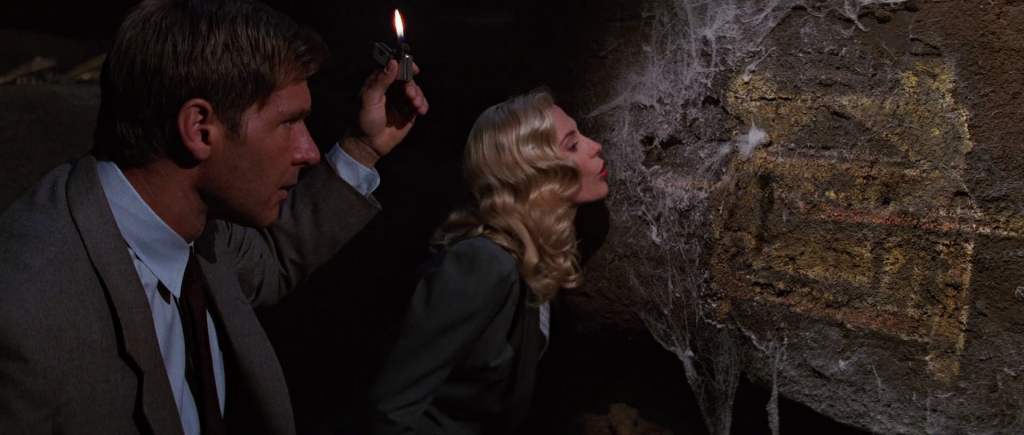
Elsa: What’s this?
Indiana Jones: Ark of the Covenant.
Elsa: Are you sure?
Indiana Jones: Pretty sure.
It’s a quick little joke, but it lands because Indy says it with the kind of casual certainty only a man who knows what happens when Nazis open things they shouldn’t. (Granted, he and Marion had their eyes shut the whole time, so all they really heard was screaming, melting, and the wrath of God doing whatever it is the wrath of God does.) It gets even funnier once you make your way down to The Field Notes and realize why Elsa likely had no idea what she’s looking at.
THE MOMENT MY WIFE FORGOT I WAS IN THE ROOM
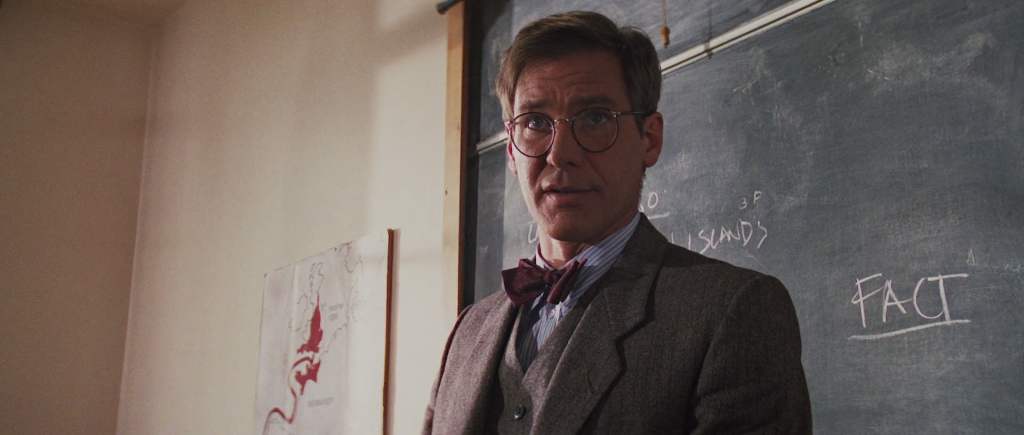
This was a tougher call than I expected. I gave my wife three different examples, and to be fair, she liked all of them. But the one above was her final answer. Keep in mind, all three came from the exact same scene.
Naturally, I thought that settled it. But then, a little later in the movie, she informed me there was another moment I needed to account for. And what moment was that? Well… this one.
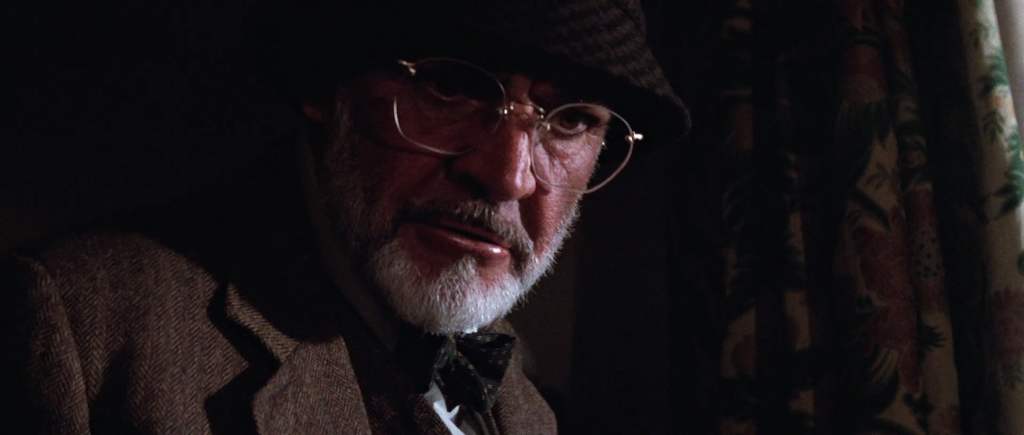
And that’s when I realized Last Crusade was working overtime against me. It’s hard enough competing with Harrison Ford. Then they throw silver fox Sean Connery into the second act, and at that point I never really stood a chance.
THE DON’T TELL ME HOW AWARD
1989’s Don’t Tell Me How Award goes to the SFX crew at Industrial Light & Magic for somehow convincing me that Indiana Jones takes a literal Leap of Faith as the final test before reaching the Grail chamber.
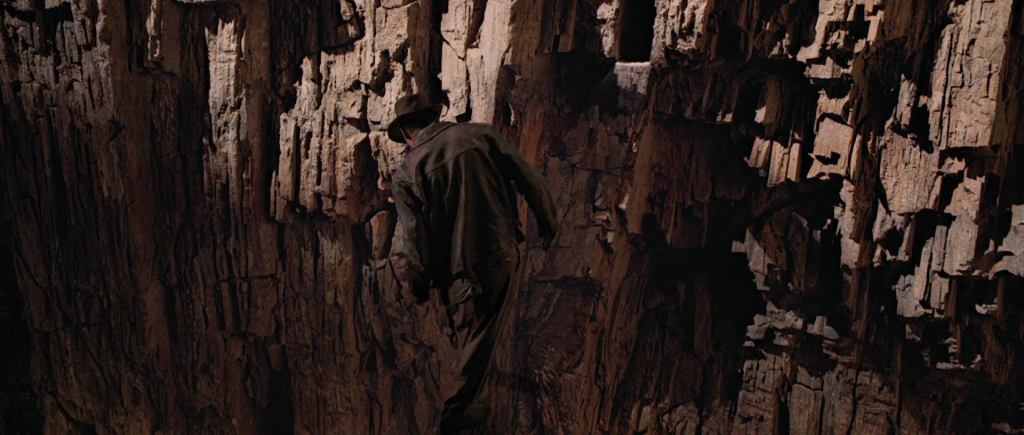
This movie is pushing forty years old, and after thirty-seven years of watching that scene, I’m still dumbfounded by how good it looks. I know it’s all perspective. I know it’s an optical illusion. Hell, if you look closely enough, you can even sort of make out the plank stretching across to the Grail chamber.
And yet… it still works.
I know there’s a perfectly logical explanation behind it. But the second I learn the trick, the magic’s gone. I don’t want to know how the sausage is made. After all these years, whenever I watch Last Crusade and this scene comes up, I’m thirteen years old again—and I’m just not willing to trade the wonder for the answer.
THE FIELD NOTES
SPIELBERG’S SECRET WESTERN
Is Indiana Jones and the Last Crusade the closest Steven Spielberg ever came to directing a western? The more I watch it, the more I think the answer might be yes.
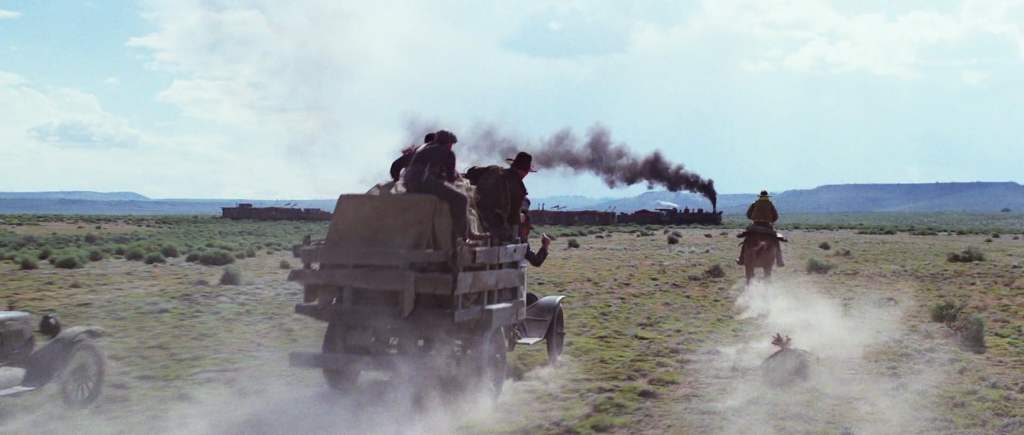
Spielberg grew up on John Ford westerns, and you can feel that influence all over Indiana Jones and the Last Crusade. It begins in Monument Valley—likely shot from Ford’s Point itself—and never really lets go. Horse chases. A train sequence. Indy on horseback chasing down a tank. Fathers and sons. Men chasing legends across wide-open landscapes.
And then, of course, it ends the way all great westerns should: with its heroes riding off into the sunset. Maybe Last Crusade isn’t just an Indiana Jones movie. Maybe it’s Spielberg’s John Ford western in disguise.
A SWARMING HORDE OF… STUDENTS?
Is it just me, or do the images below look less like an adventure movie and more like they were taken from a zombie flick?
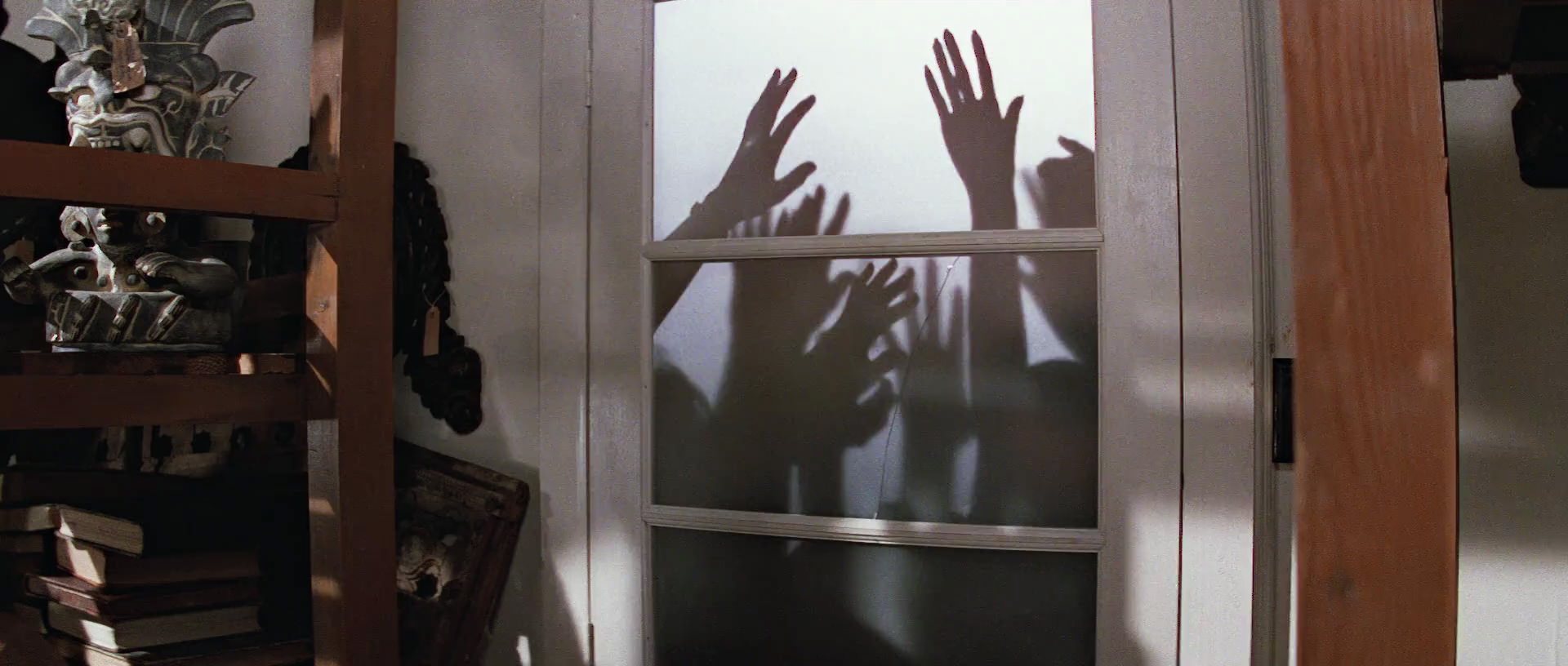
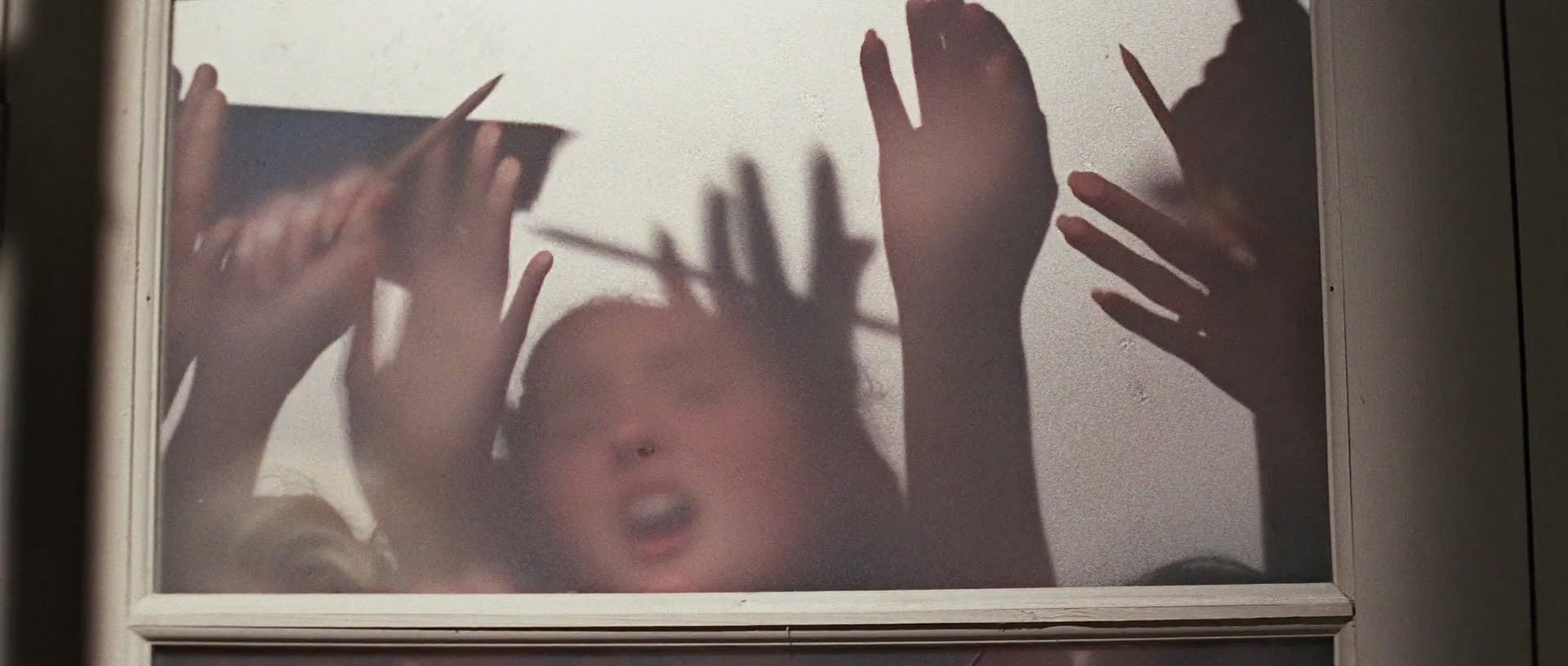
Every time Indy walks into class, he’s immediately surrounded by a slow-moving swarm, all reaching for him like he’s the last surviving man on Earth. Maybe snakes aren’t his only fear.
It does make you wonder: when the fedora comes off and the tweed goes on, does being surrounded by students feel all that different from falling into a pit of snakes? I’ll let you decide.
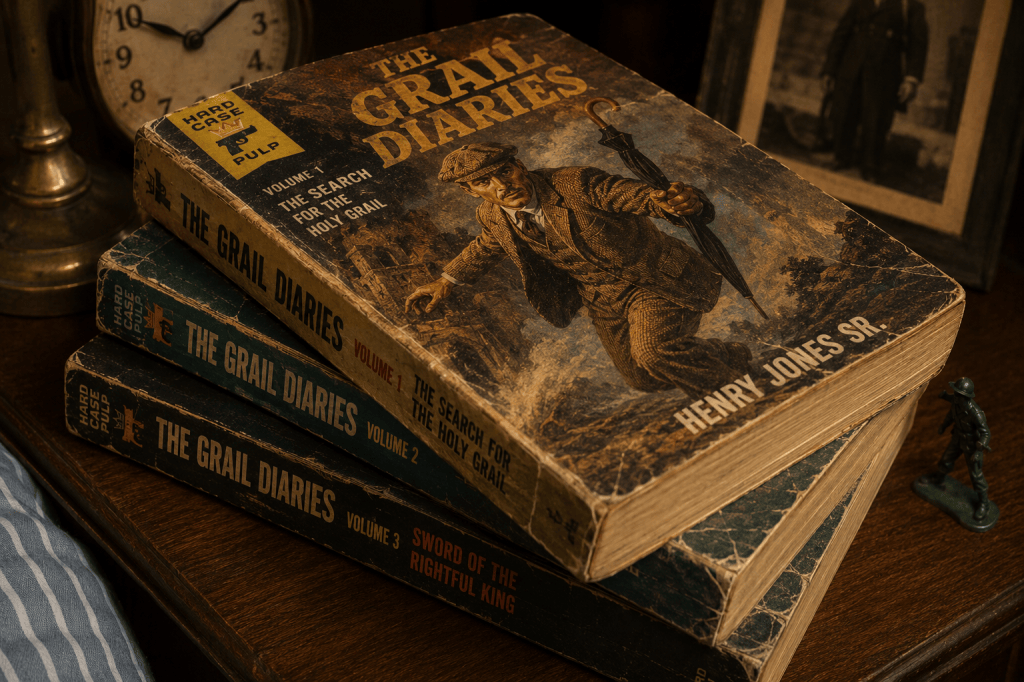
THE GRAIL DIARIES
The more I think about Henry Jones Sr., the more it feels like he spent twenty years accidentally starring in his own serialized pulp adventure—an obsession that was already in full swing long before Mrs. Jones was expecting Junior.
Somewhere out there are at least a dozen battered paperbacks chronicling his endless search for the Holy Grail, each one ending with Henry uncovering another clue while somehow missing another chunk of his son’s childhood.
Of those twelve volumes, only nine are still on the shelf at the Moab Public Library. The other three were probably loved to death by some kid reading under the covers with a flashlight. I’d hate to see the late fees on those.
By the time Indiana Jones and the Last Crusade begins, we’re not meeting a scholar at the start of his journey. We’re meeting a man who’s spent a lifetime choosing the Grail over just about everything else—but most importantly, his son.
And I can already picture them—a few of those books stacked on some kid’s nightstand, their covers creased and corners bent from being read over and over again. Carried to school in a backpack. Read during recess, at lunch, on long train rides, or while visiting grandparents for the weekend. The kind of books you read front to back three or four times during summer break because they made the world feel bigger than the one outside your bedroom window.
INDY LOGIC: THE NAZIS NEVER LEARN
By 1938, the Nazis are running the exact same playbook they used in Raiders of the Lost Ark: locate an ancient artifact, weaponize its supernatural power, and hope Hitler’s obsession with the occult finally pays off. The only difference is the Ark promised divine wrath, while the Holy Grail promises eternal life.
Which raises the obvious question:
Do they ever actually learn?
The funny thing is, from their perspective, there probably wasn’t much to learn from 1936. Everyone on that island who looked into the Ark died. Not even the one soldier who was probably left as a precaution to guard the U-Boat survived. Melted. Exploded. Completely unmade by God Himself. No surviving witnesses. No official reports. No warning labels.
As far as the Third Reich is concerned, Raiders was probably just another failed expedition. I can see it now—Hitler being handed a telegram that reads:

And then… nothing.
INDY LOGIC: THE GRAIL KNIGHT
What’s always bothered me is the sheer logistics of the Valley of the Crescent Moon and everything beyond it leading to the Holy Grail.
Who exactly built all of this?
The three brothers from the First Crusade find the Holy Grail, and somehow their immediate response is to construct three elaborate death traps, a hidden chamber, an invisible bridge, and an eternal security system designed to test the worthiness of whoever eventually showed up.
With what resources? Whose idea was that?
Did they hire contractors? Were there medieval architects specializing in giant spinning blade traps? Did somebody draw the short straw and get told, “Congratulations, you live here now until your replacement arrives, or the end of time. Whichever comes first.”
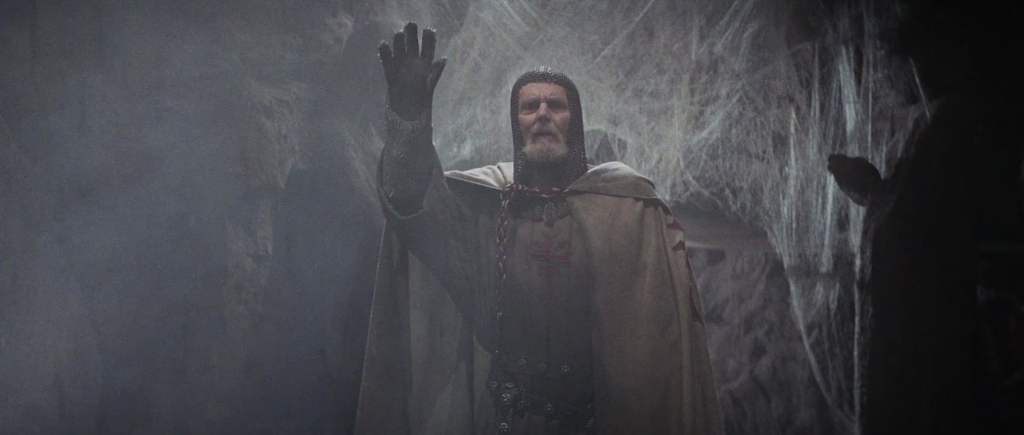
And that’s the real kicker. They made it so difficult that almost nobody was ever going to make it there in the first place—and at some point, the Brotherhood of the Cruciform Sword showed up and somehow made it even harder.
So what exactly was the Grail Knight’s long-term plan here? Hug his brothers goodbye, settle into the cave for eight hundred years, do a little light reading, polish some cups, and wait for someone to guess correctly?
And let’s not forget: these were three French knights from the First Crusade. So how exactly did the Grail Knight learn English?
Sure, eight hundred years gives you plenty of time to pick up a new language, but from where? Who was bringing him books? Did part of his Crusader starter gear include How to Learn English in Ten Easy Steps? Was there a Rosetta Stone delivery service I’m somehow unaware of?
I have questions.
If Indy hadn’t been in such a hurry to save his father, I’m convinced he would’ve had a few of his own.
Then again, maybe the Grail Knight was secretly relieved when Elsa crossed the Great Seal and doomed them all. Eight hundred years on the job is a long time. At some point, death probably starts looking like retirement.
THE ARTIFACT ROOM
THE MOST PATHETIC ATTEMPT AT CASHING IN
If you thought Hollywood was the only place trying to capitalize on Last Crusade in 1989, television was right there keeping pace.
Just a few months after Indy went searching for the Holy Grail, MacGyver kicked off its fifth season with a two-part episode called Legend of the Holy Rose, which—because subtlety was apparently dead by then—also sends Mac on a globe-trotting quest for the Grail.
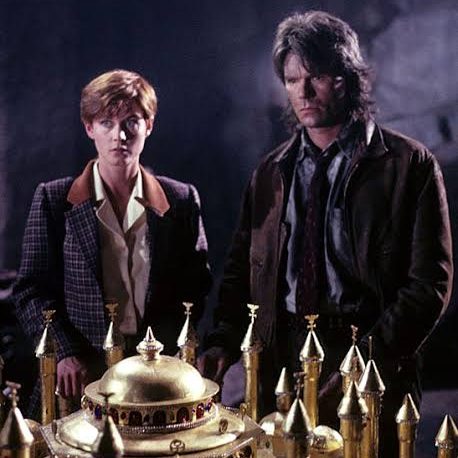
Look, I love MacGyver. Okay, wait. That’s not completely true. I like MacGyver. But let’s call this what it was: network television seeing Spielberg and Lucas strike gold and immediately trying to build their own cheaper map to the treasure.
I remember watching this two-parter once. And considering how many times I’ve watched Indiana Jones and the Last Crusade, the fact that I’ve only seen it once should tell you everything you need to know.
INDY’S INCONSISTENT THREAT
For the third film in a row, Pat Roach was meant to be one of Indy’s physical obstacles. This time he was cast as a Gestapo agent, continuing one of the strangest little traditions in the franchise… and then his entire scene got cut.
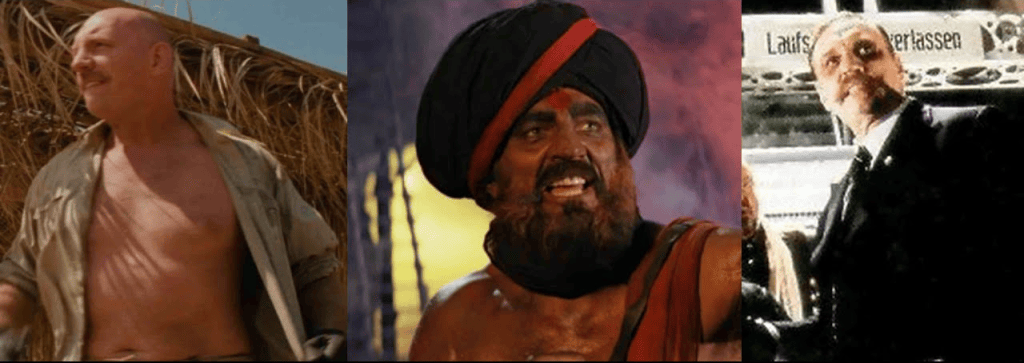
For the first time in the series, Indy’s most consistent threat never even got the chance to throw a punch. Still, if you look closely the next time you watch Indiana Jones and the Last Crusade, you can catch Pat Roach making one final blink-and-you’ll-miss-it appearance, running with Colonel Vogel as they board the departing Zeppelin.
BIGGEST PAIR OF BRASS BALLS
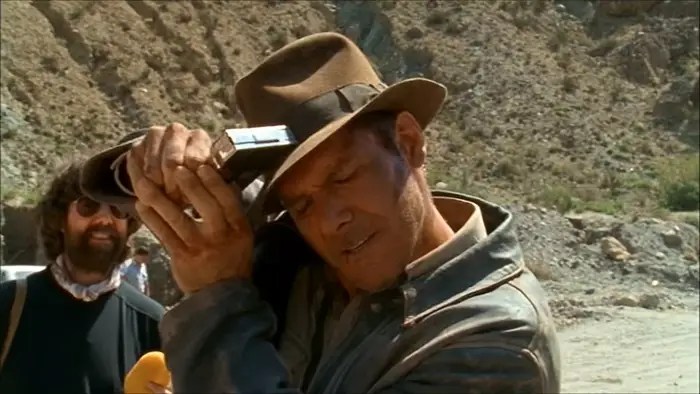
No, this isn’t a staged photo. Harrison Ford really did staple his fedora to his head to keep it from flying off during filming. Or he’s just been committed to the bit for so long—maybe the staple gun was empty—that he still claims he has the scars to prove it.
THE JONES BOYS ARE AT IT AGAIN
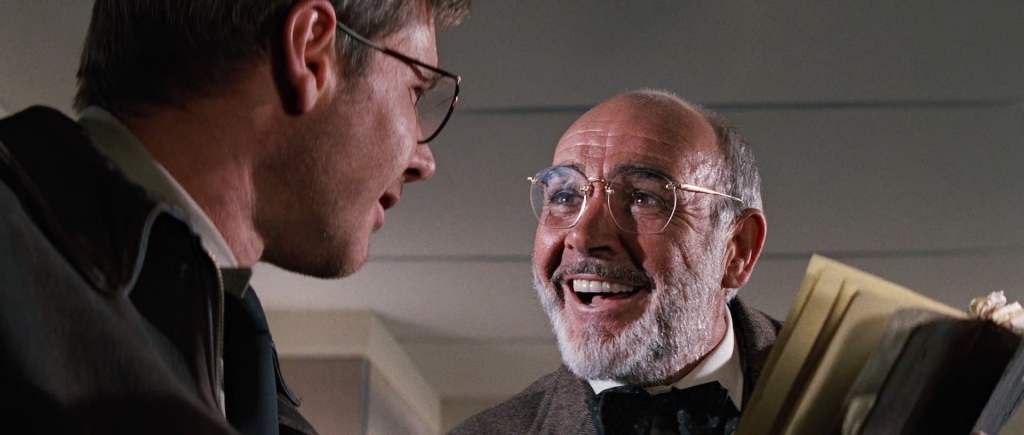
While the title sounds like a newspaper headline ripped straight out of 1938, the story behind it is much stranger. The Zeppelin sequence may look chilly on screen, but the set was anything but. The scene was meant to take place in the dead of winter, so everyone was dressed accordingly—heavy coats, layers, scarves, the whole bit. Of course, dressing for winter and actually filming in winter are two very different things.
Connery knew if he stayed fully dressed under all those lights, he’d be sweating through the entire scene. So in true Sean Connery fashion, he found his own solution.
Or rather… his own lack of trousers.
And as Connery later told it in the making-of documentary, Ford wasn’t far behind. Before long, both Jones boys were filming the Zeppelin scene without pants.
CLOSING THE JOURNAL
Alright, let’s address the elephant in the room. Is Last Crusade better than Raiders of the Lost Ark? That’s the eternal debate among Indiana Jones fans, isn’t it?
And let’s just clear something up right now: nobody’s seriously arguing Temple of Doom is the best. Those people usually get shut down immediately and are then gently encouraged to seek therapy.
But does Last Crusade have the strongest case? Maybe. And here’s why.
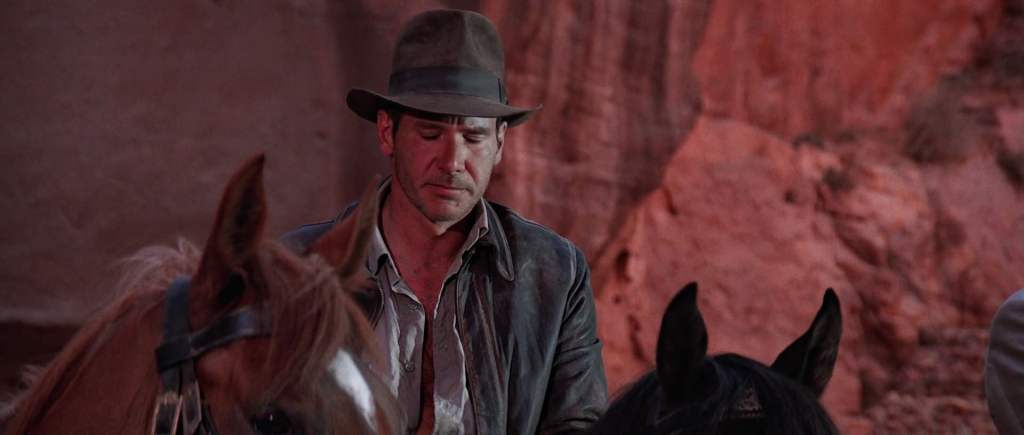
First, there’s the father-son dynamic. The chemistry between Harrison Ford and Sean Connery gives the film genuine heart and humor, while also forcing Indy into his most vulnerable and emotionally honest arc in the entire series.
Then there’s the pacing. Some fans and critics argue Last Crusade moves better than Raiders, claiming Raiders occasionally gets bogged down in its own mythology. I don’t know if I fully agree with that, but opinions are like… well, let’s not finish that sentence. To each their own.
Just remember: Indy’s dad doesn’t even properly show up until forty-eight minutes into this movie. And no, him holding up a finger and telling young Indy to count to ten in the cold open does not count.
Before Henry ever enters the picture, Last Crusade is busy building its own mythology—working through Grail lore while Indy follows a trail of clues leading him toward both the cup… and the father who’s spent his life chasing it.
Then there’s the emotional climax. And this is where Last Crusade might have the edge.
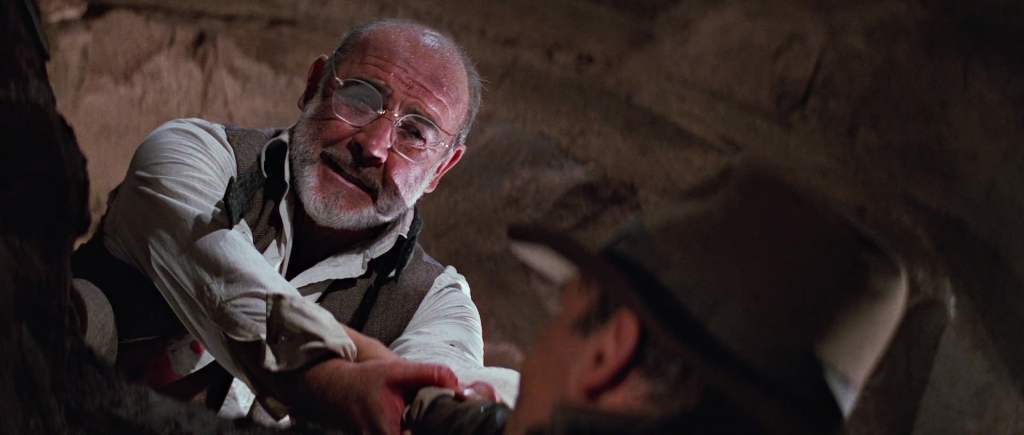
Indy has to physically and metaphorically let go of the Grail to save his father. And when Henry tells him, “Let it go, Indiana,” calling him by the name Indy chose for himself instead of Junior, the whole movie clicks into place. After twenty years of distance, obsession, and misunderstanding, these two men finally see each other for who they are. And that matters.
Then there’s rewatchability—and yes, I’m counting that as a real word whether Webster agrees or not. Last Crusade might be the most rewatchable film in the franchise—or trilogy, if you’re one of those people. (Myself included.) It perfectly straddles that line between fantasy and reality, balancing high-stakes adventure, sharp banter, slapstick comedy, and supernatural mystery without ever tipping too far in any one direction.
That said, Raiders still carries the greater historical weight. It’s grittier. Leaner. Meaner. It arguably has the stronger noir DNA and more iconic individual set pieces. But Last Crusade? It has heart.
And in the end, regardless of where you land, if you love either one more than the other… you have chosen wisely.
P.S. It’s been over a decade since I last dug into Indy’s next adventure, so I still can’t decide if I’m dreading it or looking forward to it. Either way, I have a feeling things are about to get a little weird… and not in the Ark of the Covenant kind of way.
P.P.S. Congratulations. You’ve officially survived what will likely be the three longest entries in the JONESing series. Why? Because I honestly can’t imagine Crystal Skull or Dial of Destiny pulling five thousand words out of me. But then again… stranger things have happened.
P.P.P.S. Regarding the last post post script, I was wrong.


Leave a Reply